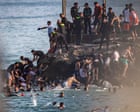
34 Dead as Thousands Storm Spanish Enclave Ceuta From Morocco
At least 34 people died during a mass migration event as over 40,000 individuals crossed into Spain's Ceuta enclave from Morocco.
At least 34 people have died attempting to reach the Spanish enclave of Ceuta after more than 40,000 migrants entered the territory from neighboring Morocco within hours. The surge, which saw individuals swimming across or scaling the border fence, has resulted in what local authorities are calling a "serious humanitarian crisis" and has triggered political criticism from other European Union nations.
Spain's Prime Minister Pedro Sánchez described the influx as a "violation of Spain's territorial integrity." He attributed the mass crossing to "human trafficking mafias" that exploited a recent Spanish Supreme Court ruling. The court determined that individuals intercepted at sea attempting to enter Ceuta or the nearby enclave of Melilla could no longer be summarily returned under special rules.
"That has spread like wildfire during these last few hours through the networks of mafias that traffic in human beings and has produced an avalanche of the characteristics and dimension that we experienced yesterday," Sánchez stated. The prime minister, facing pressure from political opponents and fellow EU countries, announced plans for a temporary reception center to process, document, and expedite the expulsion of those without legal claims to remain in Spain.
In response to the court's ruling and the unprecedented scale of the migration, the Spanish government also intends to install a visible barrier of buoys near the breakwater at Ceuta's Tarajal beach. This measure aims to clearly delineate the border and comply with the legal requirements set forth by the court, while also attempting to deter future mass crossings.
The sheer number of arrivals overwhelmed the city of 85,000, leading to chaotic scenes and a significant strain on resources. Local police associations have highlighted the dire humanitarian situation, with many individuals arriving exhausted and in need of immediate assistance. The deaths occurred due to drowning and crush injuries amidst the large-scale movement.
EU nations have voiced concerns and criticism regarding the management of the external borders and the implications of such large, uncontrolled movements of people. The incident underscores the ongoing challenges faced by Spain and the wider European Union in managing migration flows from North Africa.
Further details regarding the nationalities of the deceased and the exact circumstances of their deaths are still emerging. Authorities are working to identify individuals and process the large number of migrants who have entered the enclave, while also addressing the immediate humanitarian needs.
The long-term implications of this event are significant, potentially reshaping migration policies and border security strategies for Spain and the EU. The incident also raises questions about the effectiveness of current border control measures and the international cooperation required to address the root causes of migration.
This article was written by AI based on publicly available news reporting. Original reporting by the linked source.