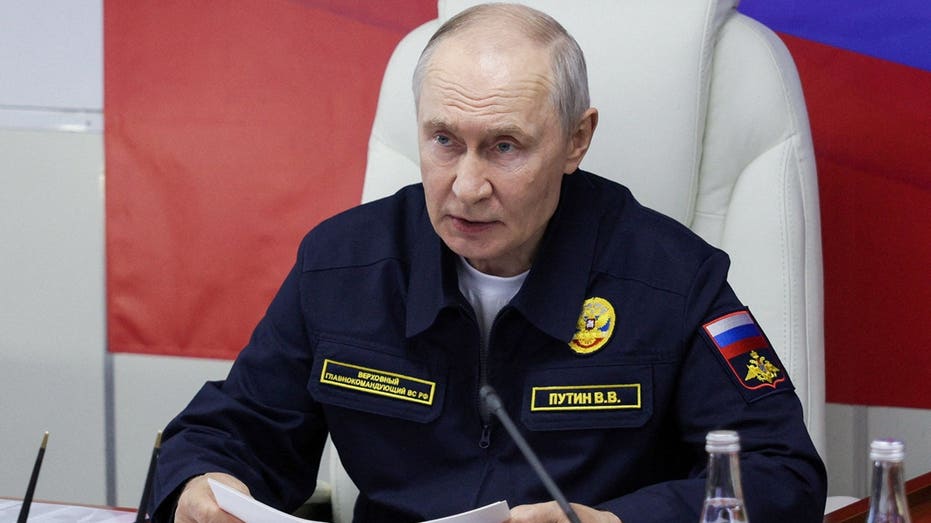
Ambassador Sondland: Putin's 'Godfather Test' exploits every attack as a mystery
Former Ambassador Gordon Sondland argues Putin uses ambiguity, akin to 'The Godfather,' to deflect blame for state-sponsored aggression.
Former U.S. Ambassador to the European Union Gordon Sondland has introduced the concept of the "Godfather Test" to describe Russia's strategy of deflecting blame for state-sponsored aggression. Sondland argues that President Vladimir Putin employs a tactic of creating ambiguity and plausible deniability around acts of sabotage and interference, much like the fictional mafia boss in "The Godfather" who operates through intermediaries and denies direct involvement.
This "Godfather Test," as outlined by Sondland, suggests that Putin's regime consistently engineers situations where direct attribution is difficult. Instead of overt declarations of responsibility, Russia allegedly orchestrates events that can be dismissed as accidents, the work of rogue actors, or the actions of other nations. This deliberate obfuscation allows Russia to pursue its geopolitical objectives without facing the full consequences of its actions.
Sondland posits that this strategy has been evident in various incidents, including cyberattacks, disinformation campaigns, and alleged sabotage. By creating a fog of uncertainty, Russia aims to avoid unified international condemnation and retaliatory measures that could be imposed if its involvement were irrefutable. The "Godfather Test" implies a calculated approach to international relations, prioritizing deniability over direct confrontation.
This method of operation, according to Sondland, presents a significant challenge for NATO and other international bodies. The lack of clear attribution makes it difficult to formulate appropriate responses, whether diplomatic, economic, or military. The "Godfather Test" highlights the need for a robust intelligence apparatus and a unified international stance to counter such ambiguous threats.
Sondland, who previously testified in the impeachment inquiry against former President Donald Trump, draws parallels between Putin's alleged tactics and the operational methods of organized crime. He suggests that Putin has mastered the art of projecting an image of innocence or detachment while benefiting from the destabilizing effects of covert or deniable operations.
The strategy's effectiveness, Sondland implies, lies in its ability to sow discord and erode trust among adversaries. By making every attack a potential mystery, Russia can keep its opponents off balance and prevent the formation of a cohesive front against its activities. This approach leverages the inherent difficulties in proving state-sponsored malfeasance in the digital age.
Ambassador Sondland's framework calls for a re-evaluation of how democratic nations perceive and respond to Russian aggression. It suggests that merely reacting to proven acts is insufficient and that a proactive strategy is needed to anticipate and counter the deliberate ambiguity employed by Moscow. The "Godfather Test" serves as a warning that Russia's actions are not random but are part of a sophisticated, long-term strategy.
Ultimately, Sondland's analysis urges NATO and its allies to develop mechanisms to hold Russia accountable even when direct proof is elusive. This might involve collective intelligence sharing, preemptive sanctions based on strong circumstantial evidence, and a clear articulation of the "Godfather Test" itself to educate the public and policymakers about the nature of the threat.
This article was written by AI based on publicly available news reporting. Original reporting by the linked source.