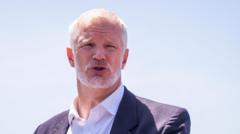
Armed Forces Minister Al Carns Quits Over Defense Funding Row
Armed forces minister Al Carns resigned Thursday, citing insufficient military funding, following Defence Secretary John Healey's exit.
Armed forces minister Al Carns has resigned from the government, becoming the second high-profile departure in a dispute over military funding. Carns announced his resignation on Thursday evening, stating that the government's defence investment plan (DIP) was neither transformative enough nor sufficiently funded. His decision follows that of Defence Secretary John Healey, who quit earlier in the week, issuing a scathing letter warning that proposed military spending levels fall "well short" of what is needed to protect the United Kingdom.
Carns' resignation deepens a significant row within the government concerning the adequacy of its defense budget. Healey's departure marked a substantial blow to Prime Minister Sir Keir Starmer, as Healey was considered one of his most loyal cabinet allies. The security minister and former British Army officer, Dan Jarvis, has been appointed to replace Healey in the cabinet.
In his resignation letter to Prime Minister Starmer, Carns stated he "could not defend a level of investment I know to be inadequate to the task." This came after he had previously suggested he was willing to wait for the finalization of the DIP before reconsidering his position. However, following candid interviews with Sky News and the BBC, he formally submitted his resignation.
Pamela Nash, a Labour MP and Healey's former parliamentary assistant at the Ministry of Defence, also resigned. Nash cited "delays and difficulties with securing the necessary funding to progress the defence investment plan" as an issue damaging public trust. The BBC understands that Healey had encouraged other defense ministers to remain in their posts.
The series of resignations has left the government in a precarious position, further undermining the authority of Prime Minister Starmer, whose long-term tenure had already been subject to speculation. Healey's decision to leave is particularly impactful given his close ties to Starmer.
Conservative leader Kemi Badenoch commented on Healey's resignation, calling it the "honourable thing" and expressing shock at the suggestion that current defense spending could put troops at risk. The timing of these resignations is also significant, occurring just a week before a crucial by-election in which Labour candidate Andy Burnham is seeking election.
Prime Minister Starmer, in his response to Healey's resignation, expressed pride in the government's funding record and asserted that the defense funding plan "will provide the resources our military needs to keep us safe." No immediate response has been issued by Sir Keir regarding Carns' departure.
The ongoing dispute highlights a critical debate about national security priorities and the financial commitments required to maintain a robust defense capability in the face of evolving global challenges. The adequacy of the government's defense investment plan remains a central point of contention.
This article was written by AI based on publicly available news reporting. Original reporting by the linked source.