Burnham Shines on Public Stage, But Lacks Time to Refine Ideas
Andy Burnham excels at public speaking and outlining his vision, but faces challenges in developing concrete policy proposals.
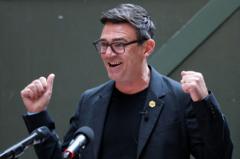
Andy Burnham, the Mayor of Greater Manchester, demonstrates a remarkable comfort and confidence on the public stage, readily engaging with microphones and cameras, and improvising responses to unfolding events. This ease in the spotlight, coupled with a passionate articulation of his vision for a better society, sets him apart, according to political editor Chris Mason.
This ability to project a clear vision and connect with the public is a stark contrast to the perceived pragmatism of current Prime Minister Rishi Sunak and, for some, a notable difference from Labour leader Sir Keir Starmer. While Starmer's approach was characterized by adaptability and a less fixed worldview, critics often found it difficult to discern his core beliefs. Burnham, conversely, appears to have a more defined sense of his convictions, a trait that has generated relief and even joy among some within the Labour party.
However, this public persona and visionary outlook come with a caveat. Despite his flair for grand ideas, Burnham faces scrutiny regarding the practical development and refinement of his policies. Elements of past criticism regarding indecision have resurfaced, particularly in light of his shifting stances on issues such as the Waspi women campaign, government borrowing rules, and trans rights. The challenge lies in translating his broad aspirations into actionable plans.
The implications of Burnham's approach are significant, particularly as he seeks to extend his political outlook, honed during his tenure as Mayor of Greater Manchester, to the national level. His focus on devolution—transferring power away from Westminster—is central to this ambition. The re-examination of his co-authored book, 'Head North,' by political circles underscores the search for concrete policy blueprints.
Burnham's vision for rebalancing power in Britain, as outlined in recent policy announcements, draws parallels to historical models of federalism. He has pointed to the post-war reconstruction of Germany, where allied powers established regional autonomy in the Lander to prevent centralized power in Berlin. This historical precedent serves as a conceptual foundation for his proposals to empower individual regions within the UK.
The 'No 10 North' plan, a key initiative, aims to decentralize government functions and decision-making, ostensibly to foster economic growth and address regional disparities. The success of this plan, however, hinges on its practical implementation and the extent to which it can overcome the inertia of existing centralized structures.
While Burnham's public performances and clear articulation of a future direction are compelling, the critical question remains whether he possesses the time and the detailed policy frameworks to translate these aspirations into tangible results. The intensity of the political cycle and the complexities of national governance present a formidable challenge.
Ultimately, the narrative around Andy Burnham is one of a politician who excels at inspiring on the national stage and sketching out broad societal improvements. Yet, the crucial next step involves demonstrating the capacity to meticulously shape these ideas into concrete policies that can withstand the rigors of governance and deliver on his promises.
This article was written by AI based on publicly available news reporting. Original reporting by the linked source.