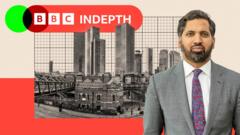
Burnham's 'Manchesterism' model aims for national transformation post-No. 10 bid.
Andy Burnham, blocked from parliament, pivoted to ambitious city plans, now eyes national application of 'Manchesterism'.
Andy Burnham, having been prevented from standing for parliament by Labour's ruling executive five months ago, has turned his focus to ambitious plans for his city region. During a meeting in his Manchester mayor's office, Burnham outlined his vision for "Manchesterism," a political-economic philosophy he believes can offer a programme for national transformation.
This approach is rooted in a critique of a currently unresponsive, over-centralised British state. Manchester itself has a long history of blending free-market principles with a strong social conscience. Historically, its cotton traders championed free trade and liberal economics, coinciding with the rise of the co-operative movement, trade unions, and the Suffragettes. Even significant infrastructure projects like the Manchester Ship Canal, an emblem of monopoly-breaking free trade, required local government intervention and worker support.
Burnham's civic ambition is evident in recent bold gestures. He planned to appeal directly to Fifa to host the 2035 Women's World Cup final in Manchester rather than Wembley, aiming to inspire girls across the north of England. He also initiated a collaboration with other mayors for a "Great Northern Olympic bid" across the north of England and a plan to host the Ryder Cup in Bolton, aiming to re-educate sports bodies about the potential beyond London. Manchester has already successfully attracted the Brit Awards from London after a 50-year residency.
The concept of "Manchesterism" as a potential model for national revival has been discussed even before Burnham's return to parliament. The philosophy is seen as offering a pathway to national transformation by addressing the perceived centralization and unresponsiveness of the UK's state apparatus.
To understand contemporary Manchester's rise, one must look back to the summer of 1996. The IRA detonated the largest bomb in the UK since World War Two, devastating Manchester's city centre. The subsequent reconstruction marked a turning point, initiating the city's ascent from the decline of de-industrialisation. A group of local leaders, including political, cultural, and business figures, along with architect Ian Simpson, proposed reshaping the city centre by demolishing damaged buildings rather than repairing them.
This approach, turning disaster into opportunity, allowed for a significant reshaping of the city's geography and economy. Council leader Sir Richard Leese and his top civil servant, the late Sir Howard Bernstein, were instrumental in this transformation. The city's economic growth has made it the fastest-growing in the country.
Burnham himself experienced the necessity of leaving the North West for career advancement in his early career. He recalled taking an unpaid reporter role at the Middleton Guardian after graduating in the early 1990s, stating that many from his generation had to "go south" to progress. By 1996, he was working as an MP's researcher.
As Burnham prepares to potentially lead the nation, the key question remains whether his "Manchesterism" model, successful in revitalizing his city region, can be effectively applied to the entire United Kingdom. The unique blend of market economics and social solidarity that characterizes Manchester's development offers a compelling, albeit unproven, blueprint for national change.
This article was written by AI based on publicly available news reporting. Original reporting by the linked source.