Cairo Paints Over Tutankhamun Mural Depicting Dark-Skinned Pharaohs
Cairo authorities painted over a mural of Tutankhamun and Nefertiti with dark skin just before a state visit, sparking a cultural debate.
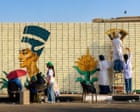
Cairo's authorities swiftly covered a large mural in Tahrir Square depicting the Pharaoh Tutankhamun and Queen Nefertiti with dark skin, just hours before Chinese president Xi Jinping's state visit last month. The artwork, part of a city beautification project commissioned for the visit, was created by the volunteer youth group Rasmet Basma.
The mural's depiction of the ancient Egyptian rulers with dark skin ignited a strong backlash from some Egyptians who viewed it as promoting Afrocentric theories about the origins of the pharaohs. These theories suggest that ancient Egyptian civilization was of black African origin and population.
Ahmed Moussa, the 22-year-old founder of Rasmet Basma, stated that the Cairo governorate requested they paint over their own work. The group had prepared the 66-meter-long mural in just five days using the AI program ChatGPT to generate designs, with volunteers then executing the painting. Moussa acknowledged a mistake in not consulting archaeology and art specialists, explaining that the chosen "golden-bronze tone" cast shadows at night, making the figures appear dark-skinned.
This incident highlights the ongoing cultural and political sensitivities surrounding the interpretation of ancient Egyptian history and identity. The rapid removal of the mural suggests an attempt by authorities to avoid any controversy or perceived alignment with specific political movements during a high-profile diplomatic event.
Controversy surrounding the mural escalated on social media, with some users questioning the artists' understanding of historical depictions and others accusing Afrocentric groups of attempting to co-opt ancient Egyptian imagery. Zahi Hawass, a prominent former antiquities minister, has been a vocal critic of Afrocentric claims, arguing against them.
The use of AI in generating the mural's design also introduces a new dimension to the creation of public art and its potential for misinterpretation or unintended controversy. The youth group's reliance on AI for quick design generation underscores a modern approach to art creation but also raises questions about historical accuracy and cultural sensitivity.
The incident underscores the complex and often contested nature of national identity and historical narratives in Egypt. The swift action taken by the authorities indicates a desire to maintain a specific public image and avoid potential diplomatic or domestic friction.
Questions remain about the long-term implications for public art initiatives in Cairo and how historical representation will be handled in future projects, especially as AI-generated content becomes more prevalent in creative fields.
This article was written by AI based on publicly available news reporting. Original reporting by the linked source.