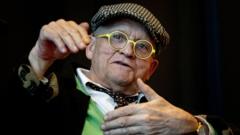
David Hockney, 88, dies; art world mourns innovative painter of vivid scenes
British artist David Hockney, celebrated for his vivid paintings and innovation across multiple mediums, has died at age 88.
David Hockney, a towering figure in the art world renowned for his vibrant paintings and groundbreaking use of diverse media, has died at the age of 88. Hockney, who became Britain's favorite artist, was celebrated for his trenchant views, expressed with a distinctive Yorkshire accent. His genius spanned paint, photography, and digital art, including etchings, lithographs, and stained glass windows, demonstrating equal mastery in grand opera design and intimate pen-and-ink sketches.
Emerging as a peroxide-blond figure with round glasses and his signature cheese-cutter hat, Hockney captivated the art world in the 1960s. His popularity endured for over half a century, with his galleries continuing to draw large crowds. A testament to his enduring appeal, one of his iconic swimming pool paintings sold for nearly £70 million at auction in 2018, setting a record for a living artist. Hockney himself expressed surprise at the public's enthusiasm, adhering to a simple guiding principle: "Paint the things you love."
Hockey's early life was shaped by his parents: his father, Kenneth, a conscientious objector who opposed social injustice, nuclear weapons, and smoking, and his mother, Laura, a strong-willed and devout Methodist. Born on July 9, 1937, in Bradford, David was the fourth of five children in a close-knit family living in a small terrace house. During wartime bombing raids, the family would hide under the stairs, clutching bibles. A street near their home was flattened by an explosion in 1940.
From a young age, Hockney was singularly devoted to drawing. Wartime paper shortages meant he often resorted to drawing on the kitchen floor or in church hymn books. Later, as a scholarship student at Bradford Grammar School, he insisted on focusing solely on art, reportedly stating in an exam that he was not good at science but could draw. Despite his passion, a tutor's report noted that "enthusiasm for Art alone is not enough to make a career."
At 16, Hockney was permitted to attend art school, arriving in a pinstriped suit and bowler hat. His appearance was flamboyant, but his work ethic was described as "Protestant," with him working intensely for up to 12 hours a day at his easel. This dedication laid the foundation for a career that would see him redefine contemporary art through his bold use of color and innovative exploration of new technologies.
Hockey's influence extended beyond traditional painting. He embraced photography, pioneering the use of composite photographs, known as "joiners," to capture a sense of movement and expanded perspective. His work with iPads and digital drawing brought a new dimension to his art, demonstrating a continuous willingness to adapt and innovate.
The art world has reacted with widespread tributes, calling him "endlessly inventive and unique." His contributions have been recognized with numerous awards and exhibitions worldwide, solidifying his legacy as one of the most significant artists of the 20th and 21st centuries.
Questions remain about the full extent of his influence on emerging artists who are inspired by his fearless experimentation and his ability to connect with a broad audience through accessible yet profound imagery.
This article was written by AI based on publicly available news reporting. Original reporting by the linked source.