Lebanon Clashes Persist as Israel, Hezbollah Accept US Ceasefire Plan
Despite accepting a US partial ceasefire, clashes continued in southern Lebanon overnight with attacks and counter-strikes reported.
Clashes have persisted in southern Lebanon despite both Israel and Hezbollah agreeing to a US-brokered plan for a partial ceasefire. President Donald Trump announced Monday that he had spoken with representatives from both sides, who had agreed to cease all shooting.
This development followed warnings from Iran that Israeli military actions in Lebanon posed a threat to a US-Iran ceasefire. Lebanon stated that Hezbollah had accepted the plan, which would halt Hezbollah's attacks on Israel and prevent Israel from targeting the Lebanese capital, Beirut. Israeli Prime Minister Benjamin Netanyahu confirmed the agreement, but stipulated that strikes on Beirut would continue if Hezbollah did not stop attacking Israeli cities and civilians. He also indicated that Israeli forces would maintain operations in southern Lebanon.
While the ceasefire appears to be largely holding, further violence was reported overnight. Hezbollah claimed its fighters had targeted Israeli tanks in the southern Lebanese towns of Haddatha and Bayada using missiles and shells. The Israeli military reported intercepting two projectiles fired from Lebanon in the early hours of Tuesday. No injuries were reported in these incidents.
The implications of these ongoing clashes remain significant. The partial ceasefire, though accepted, demonstrates the fragility of the de-escalation efforts. The continued exchanges of fire, even if limited, suggest that the underlying tensions and operational objectives of both parties are far from resolved, potentially jeopardizing the broader regional stability the US aims to achieve.
On Monday morning, Prime Minister Netanyahu announced he had ordered strikes on targets in Beirut's southern suburbs in response to rocket and drone attacks attributed to the Iran-backed Hezbollah. This action prompted strong reactions from Iranian officials. Foreign Minister Abbas Araghchi declared that the US-Iran truce constituted an "unequivocal ceasefire on all fronts, including in Lebanon," and that any violation on one front would be considered a violation across the board.
Further escalating the situation, Iran's Tasnim news agency reported that Tehran might suspend its indirect negotiations with the US concerning Israeli military actions in Lebanon. The agency, affiliated with Iran's Islamic Revolutionary Guard Corps (IRGC), also suggested that Iran and its allies could activate other fronts, potentially including the Bab al-Mandab Strait at the entrance to the Red Sea.
However, in subsequent posts on Truth Social, President Trump maintained that talks with Iran were ongoing. The source material does not provide further details on these discussions or their outcomes. The situation highlights the complex geopolitical dynamics at play, with multiple actors and potential flashpoints influencing the regional security landscape.
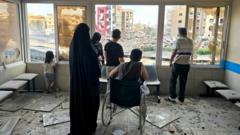
An Israeli attack on the southern Lebanese city of Tyre on Monday reportedly caused damage to the Jabal Amel hospital and destroyed a nearby building, according to Lebanon's state-run National News Agency. The agency also reported Israeli strikes on several other southern areas, and a "very violent explosion from a large-scale demolition" in the town of Debbine.
This article was written by AI based on publicly available news reporting. Original reporting by the linked source.