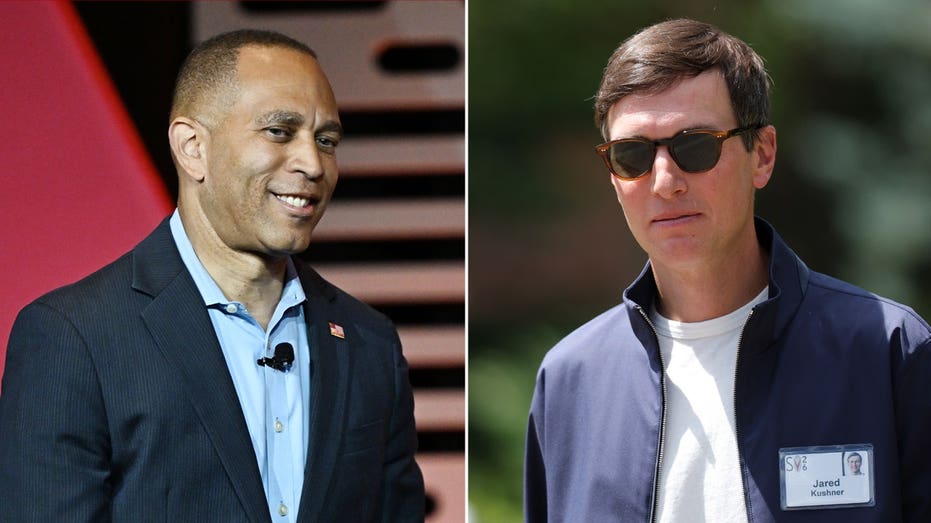
Jeffries Defends Kushner Meeting by Citing Democratic Obstruction Against Trump
House Minority Leader Hakeem Jeffries cited Democratic obstruction of Trump's agenda to defend his meeting with Jared Kushner.
House Minority Leader Hakeem Jeffries has defended his recent meeting with Donald Trump's son-in-law, Jared Kushner, by referencing the Democratic Party's past efforts to obstruct the former president's policy initiatives. The remarks came as Jeffries addressed questions surrounding his engagement with Kushner, a prominent figure in the Trump administration.
Jeffries, a key Democratic leader in the House of Representatives, explained that his conversations with Kushner were part of ongoing efforts to engage with various stakeholders across the political spectrum. He framed these discussions as a necessary component of navigating complex policy landscapes and seeking common ground where possible, even with individuals associated with opposing political factions.
According to reports, Jeffries highlighted the significant legislative and political battles that characterized the Trump presidency. He specifically mentioned instances where Democrats in Congress worked to block or impede Trump's agenda, suggesting that such actions underscore the adversarial relationship that often defined inter-party relations during that period. This context, he implied, makes his meeting with Kushner a matter of strategic engagement rather than an endorsement.
The implications of such meetings, particularly between high-ranking Democrats and figures close to former President Trump, often spark debate within political circles. Analysts suggest that these interactions can be interpreted in multiple ways, ranging from genuine attempts at bipartisan dialogue to strategic political maneuvering ahead of future elections.
Jeffries' defense suggests a pragmatic approach to political engagement, where dialogue with former adversaries is seen as a tool for understanding and potentially influencing policy outcomes. This strategy contrasts with a more purely confrontational approach, aiming to keep lines of communication open despite significant ideological differences.
The broader political environment, marked by deep partisan divisions, makes any interaction between opposing political camps a subject of scrutiny. Jeffries' justification implies a belief that engagement, even with those on the other side of significant policy disputes, is a more effective strategy than complete disengagement.
Questions remain about the specific topics discussed during the meeting and whether any potential areas of bipartisan cooperation were explored. The political calculus behind such meetings is often complex, involving considerations of public perception, party unity, and future legislative strategies.
As political dynamics continue to evolve, the nature of engagement between opposing parties remains a critical aspect of governance. Jeffries' approach, as articulated, suggests a willingness to engage in dialogue, even with figures from a previous administration, as a means of navigating the current political landscape.
This article was written by AI based on publicly available news reporting. Original reporting by the linked source.