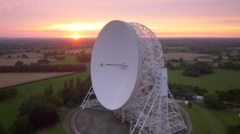
Jodrell Bank Telescope Faces Axe in Science Funding Cuts
UK's iconic Jodrell Bank Observatory loses funding, risking closure and impacting 3,000 scientists.
The Jodrell Bank Observatory, home to the UK's largest telescope for nearly 70 years, is facing potential closure after losing its funding, the BBC has learned. The observatory and its network of telescopes have been crucial for the UK's astronomical research and the training of future scientists.
This development comes as the UK Research and Innovation (UKRI) agency has decided to cut the observatory's annual £2.8 million budget, citing a need to prioritize investments that yield the greatest long-term impact. Scientists have reacted with dismay, describing the decision as "heartbreaking and scientifically misguided."
All scientific observations at Jodrell Bank are slated to cease on April 1, 2028, unless alternative funding sources can be secured. The decision places 28 jobs at the Cheshire site at risk, but the impact extends to nearly 3,000 scientists who rely on the observatory for their research.
The closure of Jodrell Bank's operations would represent a significant loss for British astronomy, potentially hindering the nation's ability to contribute to cutting-edge research and inspire the next generation of scientists and engineers.
Established in 1945, Jodrell Bank pioneered radio astronomy and played a vital role in understanding distant galaxies. During the Cold War, its capabilities were employed to monitor Soviet missile launches, highlighting its historical significance. Its contributions were recognized with Unesco World Heritage status in 2019.
However, the UKRI, with an annual budget approaching £10 billion, stated that escalating research costs for physics and laboratory operations necessitated difficult choices. The funding cut to Jodrell Bank is part of a broader 2.7% reduction in astronomy, nuclear, and particle physics research funding over the next four years.
This broader funding reduction will also affect other significant international projects. The UK will withdraw from research at the James Clark Maxwell Telescope in Hawaii, which images supermassive black holes. Funding cuts also impact the UK's involvement in instruments for the Extremely Large Telescope in Chile, designed to search for extraterrestrial life, and reduce funding for participation in the Vera Rubin Telescope project, which is creating a "movie of the Universe."
Professor Michele Dougherty, executive chair of UKRI's science and technology branch, acknowledged the difficult nature of the decisions, stating that while core research has been protected, these measures are necessary for a sustainable financial position by 2029/30. The associate director of Jodrell Bank Observatory, Professor Simon Garrington, expressed devastation, emphasizing the observatory's long-standing national importance and its role as a beacon for science in the North West.
This article was written by AI based on publicly available news reporting. Original reporting by the linked source.