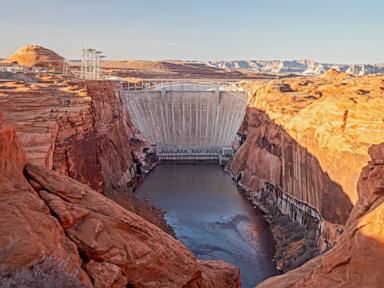
Lake Powell Nears 'Dead Power Pool' as Water Levels Plummet
Lake Powell, the US's second-largest reservoir, is just 34 feet above the 'dead power pool' level, threatening hydropower production.
Lake Powell, the second-largest reservoir in the United States, is rapidly approaching critically low water elevation levels, nearing the point at which hydropower generation will cease, experts warned. As of Monday, the water level stood at 3,524.3 feet above sea level, according to the U.S. Bureau of Reclamation tracker.
This dwindling supply places the reservoir just 34 feet above the minimum elevation of 3,490 feet, known as the 'dead power pool.' At this critical threshold, the water level is too low to operate the hydroelectric turbines within the Glen Canyon Dam, effectively halting power production for millions.
Experts highlight the severity of the situation, noting that since the Glen Canyon Dam's completion in the early 1960s, Lake Powell has never stored less than 5.26 million acre-feet of live storage. Currently, the reservoir holds approximately 5.52 million acre-feet, but it has been losing about 4,800 acre-feet daily since June 1, according to Jack Schmidt, director of the Center for Colorado River Studies at Utah State University.
The implications of dropping below 3,500 feet elevation and 4.3 million acre-feet of live storage are significant, with the Bureau of Reclamation anticipating serious concern. The situation could become even more dire if the reservoir reaches a 'dead pool' at 3,370 feet, where water can no longer flow by gravity past the dam, trapping an estimated 240 feet of water at the bottom.
The current low water levels are a direct consequence of the Colorado River Basin experiencing the lowest snowpack on record, as explained by Peter Soeth, public affairs lead at the Bureau of Reclamation. Hydrology experts had previously cautioned that water levels in the basin would approach perilous lows due to insufficient winter snowfall.
Compounding the issue, more than two-thirds of the Western United States remains under drought conditions, with significant portions of the Colorado River Basin facing severe to extreme drought, according to the U.S. Drought Monitor. This prolonged dry spell has severely impacted water availability across the region.
While there is a possibility of short-term relief, with above-average precipitation favored across the West due to monsoon season and an intensifying El Niño, experts caution that this may not offset the long-term factors. Persistent drought conditions and historically low seasonal water contributions continue to drive the region's water shortages.
Officials are closely monitoring the situation, with reservoir operations expected to become increasingly complex as water levels continue to fall. The long-term outlook for water supply in Arizona, California, and Nevada, which rely heavily on the Colorado River, remains a significant concern.
This article was written by AI based on publicly available news reporting. Original reporting by the linked source.