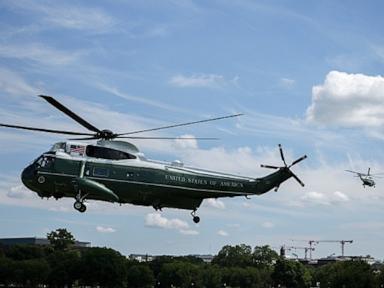
Marine One Safety Incident Occurred With Trump On Board
Marine One experienced a momentary loss of separation with a commercial flight while President Trump was aboard, prompting an investigation.
Federal officials are investigating a safety incident involving Marine One, the presidential helicopter, that occurred this week while President Donald Trump was on board. The incident involved a momentary loss of separation between the helicopter and a commercial flight.
The event took place around 2:30 p.m. ET on Tuesday as Marine One was lifting off from the Ellipse near the White House. The helicopter was en route to Joint Base Andrews in Maryland as the first leg of the president's trip to the West Coast, according to the Federal Aviation Administration (FAA).
Standard safety protocols require air traffic controllers to pause all other air traffic three minutes before Marine One is scheduled to take off. In this instance, commercial air traffic at Ronald Reagan Washington National Airport was not halted as required. An air traffic communication recording indicated that Marine One provided the required three-minute notice for takeoff, but the transmission was not fully heard by a controller due to simultaneous communication on the same frequency.
The White House stated that "at no point was the president in harm's way," emphasizing that Marine One is piloted by highly skilled aviators. The FAA confirmed that preliminary information showed a "momentary loss of separation" between Marine One and an American Airlines regional carrier flight that was taking off. However, the agency noted that the commercial flight did not get dangerously close to the presidential helicopter.
According to FAA regulations, commercial aircraft must maintain a minimum of 1.5 miles horizontal and 500 feet vertical separation from any helicopter in the vicinity of Ronald Reagan Washington National Airport. The FAA stated that this separation minimum was not compromised to a dangerous degree during the incident.
Both aviation officials and the National Transportation Safety Board (NTSB) are reviewing the incident. The FAA is continuing its safety review and indicated that it will implement corrective actions based on its findings.
The Wall Street Journal was the first to report on the incident Tuesday night. The FAA characterized the event as a "momentary loss of separation after which the aircraft continued to move away from one another."
The investigation will seek to determine the precise circumstances that led to the lapse in protocol and whether any changes to air traffic control procedures or communication systems are necessary to prevent future occurrences.
This article was written by AI based on publicly available news reporting. Original reporting by the linked source.