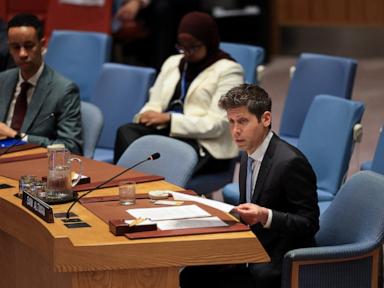
OpenAI, Anthropic CEOs urge global AI cooperation at UN, warn of risks
OpenAI and Anthropic CEOs called for international AI safety standards at the UN, warning of potential risks if development is not carefully managed.
The leaders of artificial intelligence companies OpenAI and Anthropic issued a stark warning about the potential dangers of AI to the United Nations Security Council, urging global cooperation on safety standards. Speaking at UN Headquarters in New York on September 23, 2026, OpenAI CEO Sam Altman and Anthropic CEO Dario Amodei emphasized that the world is "at a crossroads" regarding the development and deployment of advanced AI.
Their address comes amidst a rapidly intensifying global debate on how to govern increasingly powerful AI technologies. Both executives highlighted the critical need for international collaboration to establish guardrails for AI safety as the technology continues its swift advancement. Altman stated that AI could lead to either a "new renaissance of creativity and discovery" or "a new industrial revolution of upheaval and disarray."
Altman and Amodei expressed concerns that AI systems could pose significant risks if not managed properly, including the possibility of humans losing control or the technology falling into the wrong hands. Amodei specifically noted Anthropic's commitment to mitigating these risks through its operational and research practices. He suggested that AI could become a risk "to humanity as a whole" if poorly handled.
The CEOs acknowledged their companies' roles in pushing the boundaries of AI but stressed that the responsibility for managing AI risks extends beyond any single entity. They indicated a willingness to slow down the release of new AI models if potential threats are identified, countering the notion of an uncontrollable competitive race. Altman stated, "We have unilaterally slowed down in the past. We will do so in the future."
However, both leaders argued that the critical decisions about AI's future should not be confined to a few Silicon Valley companies. Altman asserted that the development of AI guardrails must be shaped through democratic processes and by governments accountable to their citizens. He added that if AI is to be democratic, "the most important decisions cannot be made by labs in San Francisco alone."
Amodei echoed this sentiment, stating that managing AI risks is "bigger than any one company and it has an industry-wide and global scale." He reiterated Anthropic's belief in its strong track record for risk prevention in the AI sector.
The joint appeal from two of the leading AI developers underscores the growing international recognition of AI's transformative potential and the accompanying challenges. The UN Security Council session provided a high-level forum for these critical discussions as policymakers grapple with the implications of this rapidly evolving technology.
While the CEOs advocated for a global, democratic approach to AI governance, the United States has previously expressed reservations about global regulatory attempts, with former President Trump reportedly stating the U.S. "rejects" such efforts. This highlights the complex geopolitical landscape surrounding AI development and control.
This article was written by AI based on publicly available news reporting. Original reporting by the linked source.