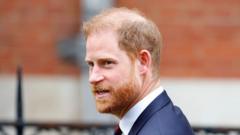
Prince Harry Loses High Court Privacy Case Against Daily Mail Publisher
Prince Harry and six others lost their High Court privacy case against the Daily Mail publisher, failing to prove unlawful information gathering.
Prince Harry and six other high-profile individuals have lost their High Court privacy case against the publisher of the Daily Mail and the Mail on Sunday. The judge, Mr Justice Nicklin, ruled that the claimants had not provided sufficient evidence to prove allegations of unlawful information gathering by the newspaper group.
The case, brought by the Duke of Sussex and a number of well-known figures, alleged that Associated Newspapers had employed unlawful methods to obtain information for its stories. These accusations were strongly refuted by the publisher, which hailed the judgment as a significant victory.
Mr Justice Nicklin stated in his summary that the serious nature of the allegations required more convincing proof than mere suspicion, even if understandable. The claimants needed to demonstrate that information was obtained through illegal means. The judge opted to rule on the merits of each individual claim rather than determining if unlawful information gathering was widespread within Associated Newspapers.
The court accepted the denials from Associated Newspapers' journalists, who offered lawful explanations for how information was sourced for the disputed articles and incidents. Furthermore, the judge found that the claimants failed to prove that three senior executives from Associated Newspapers—former editors Paul Dacre and Peter Wright, and current senior lawyer Elizabeth Hartley—had lied in their evidence to the Leveson Inquiry when they denied unlawful activity at the newspaper group.
In his extensive 436-page judgment, Mr Justice Nicklin meticulously examined each alleged breach of privacy. He frequently noted instances where suspicion about the journalists' methods of obtaining information existed, but emphasized that suspicion alone does not constitute proof. For example, an article from 2013 about Prince Harry's New Year's Eve plans was cited, where it was claimed a freelance journalist was asked to obtain travel details for his then-girlfriend. Prince Harry had described this as "creepy" and expressed concern over how the newspaper acquired such private information.
The trial saw testimony from dozens of individuals, including Prince Harry and the other claimants, as well as numerous current and former Associated Newspapers journalists and executives. Prince Harry had become emotional during the proceedings, speaking about the profound impact the articles had on him and those close to him, including making life "an absolute misery" for his wife, the Duchess of Sussex.
Among the other claimants were figures such as Sir Elton John and Liz Hurley, who were also pursuing privacy claims against the publisher. The case highlighted the ongoing tension between public interest journalism and the right to privacy for individuals, particularly those in the public eye.
While the claimants sought to establish a pattern of unlawful conduct, the court's decision underscores the high burden of proof required in such legal challenges. The ruling means that the specific allegations of unlawful information gathering in these instances were not substantiated to the court's satisfaction.
This article was written by AI based on publicly available news reporting. Original reporting by the linked source.