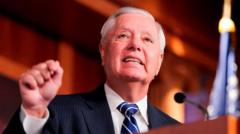
Senator Lindsey Graham dies suddenly after brief illness; met Zelensky Friday
US Senator Lindsey Graham died Saturday evening after a sudden illness, his office announced. He had just met with Ukraine's President Zelensky.
US Republican Senator Lindsey Graham has died following a brief and sudden illness, his office announced Saturday evening. The South Carolina politician, who was elected to the Senate in 2002, was a prominent voice on foreign policy and a notable figure in Washington.
Graham's family has requested prayers and privacy during this "incredibly difficult period." The announcement followed his return from Kyiv, where he met with Ukrainian President Volodymyr Zelensky on Friday. There were no known health concerns reported prior to his trip.
US President Donald Trump, in a social media post, described Graham as a "true American Patriot." Graham, who also served as Chairman of the Senate Budget Committee, was a strong advocate for US support for Ukraine, often emphasizing the global implications of the conflict.
He had recently been working on a version of the Russia sanctions bill, which he stated would provide President Trump with tools to help end the war. Graham's stance on foreign policy, particularly regarding Russia and Ukraine, was consistent, with him telling the BBC in 2023 that "Putin will not stop in Ukraine" and that "to be weak in Ukraine means that you lose in Taiwan."
Graham's political career was marked by a complex relationship with Donald Trump. While they often clashed, Graham evolved into one of Trump's staunchest supporters. In a 2023 BBC interview, Graham acknowledged a "dark side to Donald Trump" but affirmed his support, citing Trump's record on border security, the killing of Iran's Qasem Soleimani, and judicial appointments.
His passing comes as a surprise, given his recent active international engagement. Graham's influence extended beyond foreign policy, touching on fiscal matters as Chairman of the Senate Budget Committee. His death leaves a void in the Senate's foreign policy discussions, particularly concerning ongoing international conflicts.
The senator's recent visit to Ukraine underscores his commitment to the region's security and his efforts to shape US policy towards the conflict. His work on sanctions legislation was aimed at empowering the executive branch to potentially influence the war's outcome.
Details surrounding the specific nature of his "brief and sudden illness" have not been disclosed, adhering to the family's request for privacy. His passing marks the end of a significant tenure in the US Senate, during which he played a key role in shaping both domestic and foreign policy debates.
This article was written by AI based on publicly available news reporting. Original reporting by the linked source.