Seven Americans Quarantining in Kenya Ebola Facility After US Travel Ban
Seven US aid workers are quarantining in a Kenyan Ebola facility after a US travel ban, marking the first use of the controversial site.
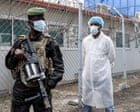
Seven American aid workers, who had been in the Democratic Republic of Congo (DRC) to combat the Ebola outbreak, are currently quarantining at a newly established isolation facility in Kenya. This development follows the implementation of new travel restrictions by the United States government. The aid workers are the first known individuals to undergo quarantine at this facility, which has faced significant opposition within Kenya and is currently the subject of a legal dispute.
The US government's policy mandates that American citizens returning from the DRC, where an Ebola outbreak is ongoing, must spend three weeks in a third country before being permitted to enter the United States. The US is constructing this 50-bed bio-isolation unit on an air force base in central Kenya specifically for asymptomatic Americans who may have been exposed to the virus in the DRC or Uganda.
Franklin Graham, president and CEO of the US charity Samaritan's Purse, confirmed that seven of his organization's American Disaster Assistance Response Team staff members are at the facility. He stated that none of the individuals are exhibiting symptoms but are being quarantined by the Kenyan government for 21 days. A US State Department official also confirmed the situation to Reuters.
The establishment of the facility has ignited considerable anger among many Kenyans, who perceive it as the US offloading potential health risks associated with Ebola patients onto their country. This public outcry led Kenya's health minister to announce an immediate halt to the facility's construction last month, after he was found in contempt of court for not adhering to an order to suspend work pending a final ruling.
Despite the legal challenges and public opposition, construction of the facility has reportedly continued, according to US officials and satellite imagery analyzed by Reuters. The facility's existence and purpose have become a focal point for concerns about public health and national sovereignty.
The opposition in Kenya has raised questions about the transparency of the agreement between the US and Kenyan governments regarding the facility. Local advocacy groups and citizens have voiced fears about the potential for an outbreak and the implications for Kenya's own healthcare system and international reputation.
This situation highlights the complex international dynamics involved in managing global health crises like Ebola. While the US aims to manage the health risks for its returning citizens, the chosen solution has created significant diplomatic and social friction with Kenya.
Further legal proceedings are expected to determine the final status of the isolation facility, while the seven Americans complete their quarantine period. The long-term implications for US-Kenya relations and public health cooperation in the region remain uncertain.
This article was written by AI based on publicly available news reporting. Original reporting by the linked source.