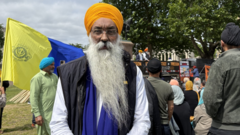
Sikh group demands public inquiry into 18-year-old's death, citing misinformation
A Sikh organization is calling for a public inquiry into the death of Henry Nowak, alleging misinformation damaged the Sikh community.
A prominent Sikh group is demanding a public inquiry into the circumstances surrounding the death of 18-year-old student Henry Nowak, who was fatally stabbed in Southampton in December 2025. The Sikh Federation, through its chief executive for political engagement, Dabinderjit Singh, has formally requested that the Home Secretary, Justice Secretary, and Attorney General initiate a public inquiry, citing damaging misinformation about the murder weapon.
Nowak was killed by Vickrum Digwa, 23. The incident gained significant public attention after bodycam footage, released with the permission of Nowak's family, showed the teenager repeatedly struggling to breathe while handcuffed and dying. This footage has prompted a jury inquest, scheduled for next year, to investigate the broader circumstances of his death.
Dabinderjit Singh stated that the narrative surrounding the weapon used in the attack has been highly detrimental to Sikhs. He has communicated these concerns directly to key government ministers. The Sikh Federation has previously asserted that the blade used was not a kirpan, a ceremonial dagger integral to Sikh religious practice.
The implications of the inquiry extend beyond the individual case, touching upon religious freedoms and the potential for misrepresentation of Sikh cultural practices. The group's call suggests a belief that systemic issues or a lack of understanding contributed to the negative portrayal and potential prejudice against the Sikh community.
Under current British law, Sikhs are permitted to wear a small blade, known as a kirpan, as part of their religious observance. However, the law stipulates that drawing such a blade in an act of aggression is illegal. Section 139 of the Criminal Justice Act 1988 provides a defense for carrying articles with blades or points in public if it is for religious reasons, a provision that also extends to items like the sgian dubh worn with Scottish Highland dress. Crucially, if the item is used in an act of violence, it is then classified as an offensive weapon.
In Nowak's case, it was reported that Digwa carried two blades. The murder weapon was described by the trial judge as a "large Sikh dagger," while Digwa was also wearing a small kirpan. The Southampton-based Sikh Federation and the Network of Sikh Organisations have maintained that the larger blade was not a kirpan but a Persian blade known as a pesh-kabz, designed for combat and worn as part of a Nihang warrior-sect subculture.
However, the Crown Prosecution Service has indicated that the judge's findings of fact supported their assessment that Digwa chose to carry two ceremonial knives and that the specific blade used was indeed a kirpan. This point of contention regarding the nature of the weapon and its religious or cultural significance appears to be central to the Sikh Federation's call for a broader inquiry.
The jury inquest next year is expected to examine these details more closely. The Sikh Federation's push for a public inquiry suggests they believe the inquest may not fully address the issues of religious misrepresentation and the impact on the Sikh community that they wish to see investigated.
This article was written by AI based on publicly available news reporting. Original reporting by the linked source.