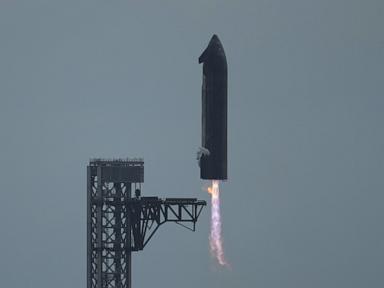
SpaceX Starship Caught by Tower Arms After First Orbital Return
SpaceX's Starship was successfully caught by launch tower arms after its first orbital return, despite its booster exploding.
SpaceX's massive Starship rocket successfully returned to Earth and was dramatically caught by giant mechanical arms at its launch pad on Saturday, marking a significant milestone for the company's reusable spacecraft program. This historic "catch" occurred 22 hours after the vehicle began its journey from Starbase, Texas.
The successful midair capture represents the first time a Starship has been recovered from orbit using this method, a feat that Elon Musk and his team had long hoped to achieve. The event demonstrated the full reusability envisioned for Starship, a rocket designed for future missions to the moon and Mars.
Despite the triumphant recovery of the upper-stage spacecraft, the mission was not without its setbacks. The first-stage booster exploded shortly after its Friday liftoff, leaving wreckage in the Gulf of Mexico. This failure prevented SpaceX from achieving its desired "double catch" of both the booster and the Starship.
SpaceX officials confirmed that the spacecraft, a stainless steel, bullet-shaped vehicle, lowered itself upright into the awaiting arms of the launch tower. "Can you believe it?" exclaimed SpaceX commentator Dan Huot during the live broadcast. "Look at her! Baby, she’s back!" The successful catch effectively overshadowed the booster's explosive failure.
NASA, a key partner in the Starship program, welcomed the news. The space agency is investing billions in Starship for its Artemis missions, which aim to land astronauts on the moon later this decade and establish a permanent lunar base. NASA Administrator Jared Isaacman described the event as "almost magic," stating it brings the world "one step closer" to lunar and Martian exploration.
The 407-foot (124-meter) rocket, the world's largest and most powerful, had successfully separated from its booster and entered orbit. During its flight, the Starship released 26 advanced Starlink satellites and completed 14 laps around Earth at an altitude of approximately 165 miles (265 kilometers), significantly outperforming previous missions.
SpaceX reported that all systems on the spacecraft, including its critical heat shield, functioned as expected. The investigation into the booster's premature engine shutdown and subsequent self-destruction is ongoing. Engineers are working to determine the exact cause of the failure.
Looking ahead, SpaceX anticipates beginning Starship launches from Florida's Kennedy Space Center within months. This new launch site will serve as the departure point for NASA's next Artemis mission, which will focus on lunar lander practice in Earth orbit before attempting a lunar landing.
This article was written by AI based on publicly available news reporting. Original reporting by the linked source.