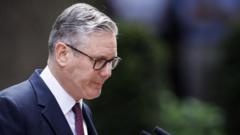
Starmer's Government Collapses After Two Years Amidst U-Turns and Internal Strife
Prime Minister Sir Keir Starmer resigned after losing the confidence of his party, marked by policy reversals and Downing Street dysfunction.
Prime Minister Sir Keir Starmer announced his resignation on Monday, bringing an end to his government after just two years in office. The political editor of BBC News, Chris Mason, described the scene at Downing Street as "extraordinary," noting that Starmer's departure was not due to scandal or economic crisis, but a loss of the capacity to govern.
Starmer's downfall follows a pattern seen with recent prime ministers, including Boris Johnson and Liz Truss, all of whom lost the faith of their own Members of Parliament. This repeated instability raises questions about the longevity of leadership in the UK, with theories pointing to economic stagnation and the pervasive influence of social media.
The contributors to the decline in confidence among Labour MPs were manifold, building over time. Early missteps included the cancellation and eventual reversal of the winter fuel payment for pensioners shortly after the party's general election victory two years prior. This was followed by controversy over "freebies" and internal "briefing wars" aimed at removing Starmer's first chief of staff, Sue Gray, within the government's initial three months.
A significant blow to Starmer's authority occurred just over a year ago with a "humiliating climbdown" on planned changes to the benefits system. This moment signaled to Labour MPs that the government could be influenced, significantly eroding Downing Street's power. The appointment of Lord Peter Mandelson as ambassador in Washington, despite his eventual sacking in September, also generated prolonged controversy that shadowed the remainder of Starmer's premiership.
Further compounding the instability, key figures departed. Morgan McSweeney, who had been a constant advisor to Starmer throughout his leadership, resigned. Additionally, a third Downing Street Director of Communications, Tim Allan, also stepped down. These departures coincided with growing discontent among Labour MPs, which had been simmering privately for a considerable period before becoming more publicly apparent.
The source material highlights that the journalist's role is to "chronicle this to the best of our ability," providing insight into events often away from the public eye. Much of the information gathered for such reporting is "off the record," indicating the complex and often behind-the-scenes nature of political maneuvering that can lead to a prime minister's downfall.
The rapid succession of prime ministers in recent years, with three leaders losing office within a four-year span, underscores a period of significant political volatility. The reasons behind this trend are subject to ongoing debate among political analysts and commentators.
Questions remain about the long-term implications for the Labour Party and the broader political landscape in the United Kingdom following this abrupt change in leadership. The capacity for any successor to establish a stable government amidst these challenges will be a key focus in the coming months.
This article was written by AI based on publicly available news reporting. Original reporting by the linked source.