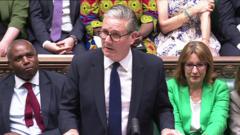
Starmer's 'political journey' ends at final Prime Minister's Questions
Prime Minister Keir Starmer declared his political journey over at his final PMQs, receiving tributes and a standing ovation.
Prime Minister Keir Starmer announced the "end of my political journey" during his final appearance at Prime Minister's Questions on July 15, 2026, before stepping down from the role. The session, which lasted 50 minutes, saw a largely subdued atmosphere as MPs from all sides set aside typical political hostilities to pay tribute to the outgoing leader.
Starmer, who is due to hand over leadership to Andy Burnham on Monday following a special Labour conference on Friday, reflected on his achievements and thanked his staff, who he described as having been "prepared to walk through fire" for him. His departure comes two years after securing a landslide election victory, a tenure that has now concluded following a decision by his own MPs.
During the session, Chancellor Rachel Reeves, a close ally, appeared emotional, while Labour MP Carolyn Harris lauded Starmer's "decency and his courage." Conservative leader Kemi Badenoch, breaking from her usual adversarial stance, commended Starmer's work on Ukraine and his relationship with President Volodymyr Zelensky, though she did make light jabs at the Labour party and its incoming leader, who was absent.
Liberal Democrat leader Sir Ed Davey described Starmer as a "true patriot" and acknowledged his cross-party collaboration. The Prime Minister also addressed guests in the gallery, including individuals whose lives had been impacted by his government, stating they were the reason he entered politics.
The final PMQs session was marked by a gentler, more humorous tone than usual, with jokes about England's World Cup prospects and a recent by-election. However, it began on a somber note as Starmer paid tribute to former MP Ann Widdecombe and reflected on the deaths of three serving or former MPs during his time in Parliament.
Badenoch also paid tribute to Widdecombe, calling her a "woman of high principle with a wicked sense of humour." The outgoing Prime Minister received a standing ovation from his own MPs as he departed the chamber, with many from the opposition benches joining in. His family watched from the gallery.
Starmer's departure follows a period where his "Mr Rules" approach, as described by the BBC, was seen as failing to connect with the public. His successor, Andy Burnham, is set to take over leadership amidst a shifting political landscape.
Questions remain about the specific reasons behind the internal party decision that led to Starmer's premature exit, particularly so soon after a significant electoral success. The transition to new leadership under Burnham will likely be closely watched as the Labour party navigates its future direction.
This article was written by AI based on publicly available news reporting. Original reporting by the linked source.