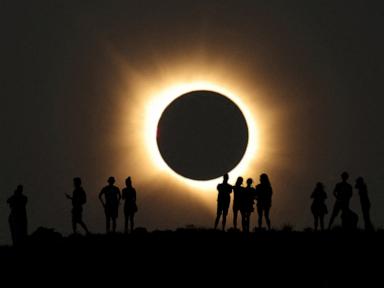
Total Solar Eclipse Dazzles Northern Hemisphere: Spain, Iceland See Totality
Millions witnessed the Aug. 12 total solar eclipse across Greenland, Iceland, Spain, and Russia, while others saw partial views.
A spectacular total solar eclipse swept across parts of the Northern Hemisphere on Wednesday, August 12, offering millions of skywatchers a rare opportunity to witness a significant celestial event.
The path of totality for the August 12 eclipse stretched across Greenland, Iceland, the Atlantic Ocean, Spain, a small part of Portugal, and northern Russia. Within this narrow band, observers were treated to the dramatic sight of the moon completely obscuring the sun, plunging daytime skies into temporary darkness.
Photos emerging from the event captured the awe-inspiring spectacle, with crowds gathering in locations along the path of totality to experience the phenomenon. In Spain, locations like Palencia and Arcos de las Salinas were central to the viewing experience, showcasing the moon perfectly aligned with the sun. Meanwhile, in Britain, people viewed a partial solar eclipse from Glastonbury Tor, and in Tunisia, a partial eclipse was visible from Soliman Beach.
For those outside the path of totality, including much of the United States, the eclipse manifested as a partial solar event. Parts of the northern U.S., from Alaska to North Carolina, were able to see a portion of the sun obscured by the moon. The International Space Station was also captured transiting the sun in silhouette during a partial eclipse near Hodgdon, Maine.
This celestial alignment has long captivated human interest, with eclipses serving as subjects of scientific study and cultural fascination for centuries. Modern astronomy allows for precise predictions of these events, enabling people to prepare and gather in optimal locations for viewing.
Astronomical agencies like NASA provided detailed information on the eclipse's visibility, guiding skywatchers on where and when to look. The differing views, from complete totality to partial obscuration, highlight the specific geometry required for observers to be positioned within the moon's umbra, the darkest part of its shadow.
Beyond the visual spectacle, solar eclipses provide valuable opportunities for scientific research. Instruments can be deployed during totality to study the sun's corona, its outer atmosphere, which is normally hidden by the sun's bright face. This research can contribute to our understanding of solar physics and space weather.
As the 2026 total solar eclipse concludes its sweep across the Northern Hemisphere, it leaves behind a trail of shared experiences and scientific data, reinforcing the wonder of the cosmos and humanity's enduring quest to explore it.
This article was written by AI based on publicly available news reporting. Original reporting by the linked source.