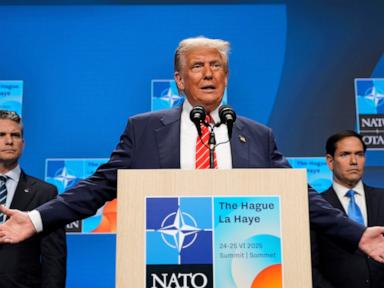
Trump meets NATO allies in Ankara amid calls for "NATO 3.0"
President Trump met NATO allies in Ankara amidst calls for a more European-led alliance, "NATO 3.0," focusing on defense spending.
Allies from both sides of the Atlantic gathered in Ankara on Tuesday for a crucial summit, testing the unity of the North Atlantic Treaty Organization, an alliance that U.S. President Donald Trump has frequently criticized.
The summit arrives against the backdrop of Trump's repeated critiques of allies' defense spending and a Pentagon review of U.S. troop presence across Europe. NATO Secretary General Mark Rutte has sought to ease tensions, stating that European allies have responded to U.S. calls for greater burden-sharing, noting a 20% increase in defense spending by Europe and Canada over the past year.
Rutte has welcomed President Trump's desire for Europeans to assume a larger share of the alliance's responsibilities, praising the president's vision for NATO and advocating for a significant boost in defense industrial capabilities. He described the current phase as "NATO 3.0," characterized by a more European-led approach and balanced defense spending, while affirming the continued central role of the United States.
European officials indicated that the summit's agenda would focus on implementing goals established at the previous year's summit in The Hague. There, allies committed to a 10-year plan to increase defense spending to 5% of their gross domestic product. However, analysts suggest that the absence of a clear, celebratory outcome in Ankara, unlike at The Hague, contributes to uncertainty, particularly as Trump continues to express dissatisfaction with allies' contributions.
President Trump himself stated last week that the U.S. significantly outspends other nations on NATO to protect them without receiving proportional benefits. The NATO meetings also coincide with an escalation of the conflict in Ukraine, with allies expected to signal their continued support for Kyiv. President Trump is scheduled to meet with Ukrainian President Volodymyr Zelenskyy on Wednesday.
The summit follows remarks by U.S. Defense Secretary Pete Hegseth in June, where he criticized allies' defense contributions as "shameful" and announced a six-month review of the U.S. military footprint in Europe. The U.S. military has already indicated adjustments to its commitment under the NATO Force Model, which designates allied assets for emergency response.
Analysts warn that potential changes to the U.S. force posture in Europe, including the cancellation of a troop rotation to Poland, could create temporary security gaps. Although President Trump publicly reversed the decision to cancel the Poland deployment, the troops have not yet been deployed.
U.S. Ambassador to NATO Matthew Whittaker, in a Monday interview with CNBC, discussed the ongoing strategic considerations for the alliance amidst these evolving geopolitical dynamics.
This article was written by AI based on publicly available news reporting. Original reporting by the linked source.