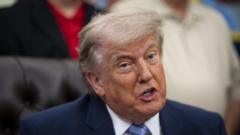
Trump Says Iran 'Getting Closer' to US Agreement, Cites Draft Deal
President Trump indicated progress toward an agreement with Iran, mentioning a draft deal, while Iran confirmed converging positions but cautioned on key issues.
U.S. President Donald Trump announced on Saturday that Iran is "getting a lot closer" to an agreement with the United States, a statement echoed by Iranian officials who also signaled progress in recent discussions.
Trump, speaking to CBS News, revealed he had seen a draft agreement with Iran. While he remained non-committal on its immediate acceptance, stating "I don't know, I can't tell you that," he emphasized that any deal would strictly prevent Iran from obtaining nuclear weapons. He added, "I will only sign a deal where we get everything we want." The President also issued a strong warning, stating that failure to reach a deal would lead to a situation where "no country will ever be hit as hard as they're about to be hit."
Iranian foreign ministry spokesman Esmaeil Baqaei confirmed that the positions of the U.S. and Iran had converged over the past week. However, he cautioned that this convergence did not guarantee agreements on critical issues and accused the U.S. of making contradictory statements. Baqaei outlined Iran's plan to first draft a memorandum of understanding or an agreement in the form of a 14-point framework. He indicated that this memorandum was being finalized to allow for further talks within 30 to 60 days, potentially leading to a final agreement.
The implications of these statements suggest a potential thaw in the strained relationship between the U.S. and Iran, though significant hurdles remain. The U.S. insistence on preventing Iran's nuclear armament and Baqaei's mention of key issues not being part of initial proposals highlight the delicate nature of the ongoing negotiations.
U.S. Secretary of State Marco Rubio, traveling in India, expressed cautious optimism, suggesting that news could emerge within the next few days, though he could not guarantee it. Rubio reiterated the U.S. stance against Iran acquiring nuclear weapons and also spoke about the possibility of reopening the Strait of Hormuz without Iranian tolls, adding that Iran would need to hand over its highly enriched uranium.
This development comes amidst broader geopolitical maneuvering. President Trump was expected to hold phone calls with leaders from Saudi Arabia, Qatar, the United Arab Emirates, Egypt, Turkey, and Pakistan on Saturday, according to Reuters. These conversations likely aim to build consensus and support for any potential agreement or to coordinate responses to regional stability.
While the source material does not provide historical context on prior agreements or specific details of the draft, the mention of Iran's nuclear program and the Strait of Hormuz indicates these are central points of contention. The U.S. has previously imposed sanctions and exerted pressure on Iran, particularly concerning its nuclear activities and regional influence.
Further details on the specific terms of the draft agreement, the timeline for future talks, and the reactions from other international players will be crucial in understanding the ultimate outcome of these discussions. Unresolved questions linger regarding the extent of concessions each side is willing to make and the verification mechanisms for any agreed-upon terms, especially concerning Iran's nuclear capabilities.
This article was written by AI based on publicly available news reporting. Original reporting by the linked source.