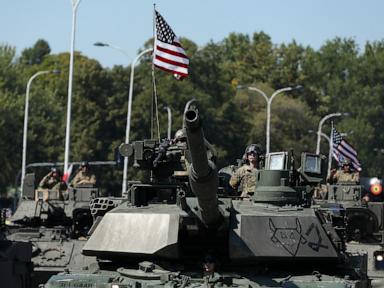
Trump announces 5,000 troops to Poland, reversing previous halt
President Trump announced 5,000 U.S. troops will deploy to Poland, appearing to reverse a recent Pentagon decision to halt a brigade.
President Donald Trump announced Thursday that the United States will send 5,000 troops to Poland, a move that appears to reverse a decision made last week by the Pentagon to halt the deployment of a U.S. Army brigade.
In a post on his social media platform, Trump stated that the decision was influenced by the recent election of Poland's President Karol Nawrocki. Trump expressed pride in endorsing Nawrocki and highlighted their relationship as a factor in the troop deployment.
Last week, the Pentagon had announced that a 4,200-strong Army brigade slated for deployment to Poland would not proceed. This decision came even though the unit's equipment had already arrived and the soldiers had undergone months of training for the mission, which would have effectively halved U.S. combat power in the country.
The implications of Trump's announcement remain unclear, as it is not entirely specified which troops will be sent, when they will arrive, or if they are related to the previously halted brigade. A Polish official indicated that diplomatic efforts in Washington may have helped influence the reversal of the planned troop cut.
While Vice President JD Vance had previously defended the Pentagon's initial plan to halt the brigade, characterizing it as a standard delay, the Defense Secretary later assured Poland's Prime Minister of a continued strong U.S. military presence. The Pentagon statement also noted Poland's self-defense capabilities and encouraged other NATO allies to follow suit.
Details regarding the deployment are scarce. It is uncertain whether the 5,000 troops announced by President Trump will originate from Germany or elsewhere, or if the original brigade from Fort Hood, Texas, will now deploy. Another possibility is that an existing U.S. unit in Poland scheduled for rotation could have its deployment extended to maintain troop levels.
This development follows a period where the U.S. military presence in Eastern Europe has been a subject of discussion and adjustment. The strategic importance of Poland as a NATO ally bordering Russia has often placed it at the forefront of discussions regarding regional security and deterrence.
Officials and analysts are awaiting further clarification on the exact composition and timing of the troop deployment. The apparent shift in strategy raises questions about ongoing defense policy coordination and the administration's approach to troop deployments in the region.
This article was written by AI based on publicly available news reporting. Original reporting by the linked source.