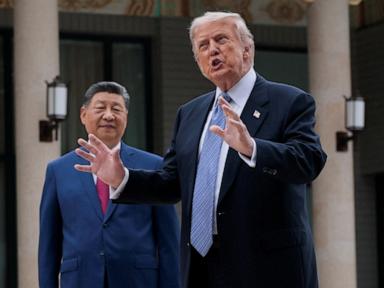
Trump stalls Taiwan arms sale following Xi Jinping's warning
President Trump indicated uncertainty on a crucial arms sale to Taiwan after concluding talks with Chinese President Xi Jinping.
President Donald Trump has cast doubt on a planned arms sale to Taiwan, signaling a potential shift in U.S. policy following discussions with Chinese President Xi Jinping. The two leaders concluded their second round of talks, after which Trump suggested the deal's future was uncertain.
This development comes amidst escalating trade tensions between the United States and China. Taiwan, a self-governing democracy, is a significant point of contention in U.S.-China relations, with Beijing considering it a renegade province. U.S. arms sales to Taiwan are mandated by the Taiwan Relations Act and are designed to help the island maintain its self-defense capabilities, a policy that consistently draws strong objections from China.
Details regarding the specific arms sale were not disclosed, but reports indicate it involves significant military equipment. President Trump's reluctance to commit to the sale, particularly after direct engagement with President Xi, suggests that trade negotiations may have influenced his stance. This move could be interpreted as a concession to China's demands regarding Taiwan.
The implications of a stalled or canceled arms sale are substantial. It could weaken Taiwan's defensive posture and embolden China's assertive actions in the region. Furthermore, it raises questions about the reliability of U.S. security commitments to its partners and could signal a broader recalibration of U.S. foreign policy under the Trump administration, potentially prioritizing trade deals over long-standing security alliances.
China has repeatedly warned the U.S. against interfering in its internal affairs, including arms sales to Taiwan. President Xi Jinping has emphasized the "one China" principle, asserting that Taiwan is an inalienable part of China. U.S. policy has officially acknowledged Beijing's position but has also maintained robust unofficial relations with Taipei and provided defensive arms.
Analysts suggest that President Trump's apparent wavering on the Taiwan arms sale could be a strategic maneuver within the larger trade dispute, or it could reflect genuine pressure from Beijing. The outcome will be closely watched by allies and adversaries alike, as it could set a precedent for future U.S. policy decisions concerning China and regional security.
Taiwan's Ministry of National Defense has not yet issued an official statement regarding President Trump's comments. However, previous arms sales have been crucial for Taiwan's modernization of its military, including fighter jets and missile defense systems, to counter China's growing military power.
Further clarity is expected as President Trump returns to the U.S. and the administration's official position on the Taiwan arms sale becomes clearer. The potential impact on regional stability and U.S.-China relations remains a significant concern.
This article was written by AI based on publicly available news reporting. Original reporting by the linked source.