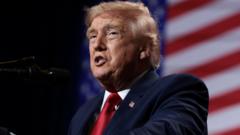
Trump's United Ireland Comments Target US Audience Ahead of Midterms
US President Donald Trump's remarks favoring a united Ireland may have been aimed at American voters, not a policy shift.
US President Donald Trump's visit to Ireland took an unexpected turn when he expressed a desire for a unified Ireland, a statement that quickly became the dominant global headline. The remarks, made on the first day of his two-day trip, left observers uncertain whether they signaled a new U.S. administration policy or were simply an off-the-cuff comment from a president known for engaging with reporters.
As shockwaves from his comments spread across the island of Ireland and Great Britain, the context and intent behind Trump's statements became a subject of intense speculation. The remarks occurred during a press conference and were later reiterated in a speech at the U.S. Ambassador's residence.
Former Republican Congressman Mick Mulvaney, who served as Trump's special envoy to Northern Ireland during his first term, advised against overinterpreting the president's words. Mulvaney stated that the comments do not represent a change in U.S. foreign policy and that the commitment to the Good Friday Agreement remains strong. Democratic Congressman Brendan Boyle echoed this sentiment, emphasizing the bipartisan support for the agreement and asserting that this stance will not change.
While both Mulvaney and Boyle acknowledged that unification might eventually occur, they stressed that the U.S. is not actively pushing for it. Trump's decision to repeat his sentiments about a united Ireland in his subsequent speech, almost as the first item, suggested he recognized the stir his earlier remarks had caused. The rest of his address, however, deviated significantly from its billed topic for Irish and Irish American business leaders, largely focusing on domestic U.S. issues.
Trump's characteristic speaking style, which he describes as a "weave," involves transitioning between topics, often veering off-script before returning to the main subject. During this particular speech, he highlighted his perceived achievements, including efforts to curb illegal immigration, strike deals, and increase defense production. He also reiterated criticisms of the UK's perceived lack of support for his military operations in Iran.
The timing and nature of Trump's comments have led to speculation about his intended audience. With the U.S. midterm elections fast approaching in November, the Republican party faces significant pressure, and the potential loss of control in one or both houses of Congress is a concern. Approximately one-tenth of the U.S. population claims Irish heritage, though they do not constitute a monolithic voting bloc.
Trump's reiteration of his desire for a unified Ireland, particularly during a speech to business leaders, raises questions about whether he was addressing the attendees in Dublin or a domestic U.S. audience tuning in early in the morning. His tendency to pivot to domestic issues and appeal to specific demographics is well-documented, and this instance may be no different.
The remarks also occurred in the presence of Irish Prime Minister Micheál Martin and Irish President Catherine Connolly, adding another layer of diplomatic consideration to the situation. The U.S. president's engagement with political leaders on the island of Ireland, coupled with his public statements on its future, underscores the complex and often unpredictable nature of international diplomacy under his administration.
This article was written by AI based on publicly available news reporting. Original reporting by the linked source.