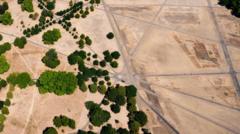
UK Faces Food Shortages as Drought Threatens Crops and Livestock
National Farmers' Union warns of potential food shortages due to prolonged drought, with crop yields and livestock feed severely impacted.
The United Kingdom faces the prospect of food shortages if current drought conditions persist, the National Farmers' Union (NFU) has warned. NFU president Tom Bradshaw stated that crop yields for wheat and oats have been "very, very poor" this year, and livestock farmers are already depleting winter feed supplies due to an inability to grow sufficient grass.
Drought has been officially declared across significant portions of England and the entirety of Wales. This follows successive heatwaves that have placed immense strain on water supplies, leading to hosepipe bans affecting over 20 million people. Amber heat health alerts are also in effect for large areas of England.
Bradshaw highlighted that the high temperatures and arid conditions are intensifying pressure across all farming sectors. Vegetable growers are reportedly facing water scarcity, which is reducing domestic food production and increasing cultivation costs. He emphasized the critical link between water security and national food security, stating that "water security is a critical part of our food security and food security is our national security."
The NFU president is urging the government to increase investment in reservoir infrastructure. He noted that substantial amounts of water that could be stored during winter months are currently being discharged into the North Sea. Bradshaw called for immediate action to prepare for future challenges, acknowledging that while current river levels are critically low, this situation must spur long-term planning.
To bolster future resilience, Bradshaw proposed tax incentives for farmers to construct water storage systems on their land. He suggested that the UK has taken its food supply for granted for too long, particularly as climate change impacts the agricultural output of other nations on which the UK relies. "It does feel like there is going be some shortages of [food] products," Bradshaw commented.
In a direct message to Prime Minister Andy Burnham, Bradshaw urged a prioritization of domestic food production to stimulate economic growth across the UK. "Let's draw a line in the sand and make sure we prioritise domestic food production to deliver growth across the UK," he stated.
Following a wet and mild start to the year, the UK has experienced exceptionally hot and dry weather, marked by a series of intense heatwaves. This combination of low rainfall and sustained high temperatures has rapidly depleted water reserves in soils, vegetation, and rivers.
While droughts are natural phenomena, climate change is increasing the erratic nature of weather patterns, making heatwaves more frequent and severe. Scientists warn this elevates the risk of droughts occurring and exacerbates their potential duration and intensity. Data from the Met Office indicates that England received only 5.6mm of rainfall by July 30, representing just 8% of its long-term average for the month and less than half of the previous record from 1911. Wales recorded 7.9mm, also 8% of its average and nearly a third of its 1911 record.
This article was written by AI based on publicly available news reporting. Original reporting by the linked source.