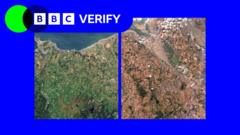
UK Heatwaves Turn Green Fields Brown, Satellite Images Reveal
Satellite data shows widespread vegetation stress across the UK due to recent heatwaves and drought, impacting agriculture and raising water shortage concerns.
Satellite imagery has revealed the significant toll taken on the UK's landscape by this year's prolonged hot summer and lack of rainfall. BBC Verify's analysis of satellite data highlights areas most affected by heatwaves and drought, showing "vegetation stress" where plant, grass, and crop development has been severely impacted.
Experts warn that the combination of minimal rainfall and extended hot weather is likely to create substantial challenges for the farming industry, with potential repercussions for agriculture and overall food supplies. Scientists are also sounding the alarm about the UK's escalating risk of water shortages in the coming decades, a trend attributed to human-caused climate change and increasing demand.
A comparison of satellite images from May and July starkly illustrates the changes in plant health across the country. The Normalised Difference Vegetation Index (NDVI), a measure of vegetation greenness and health, was used to assess these shifts. The most dramatic transformations are evident in Conwy, Flintshire, Denbighshire, and Merseyside, where areas previously characterized by green fields and grasslands now exhibit light brown tones, indicating widespread vegetation stress.
Beyond these major areas, the data points to more localized "hotspots" of stress. These include regions around Peterborough, Lincolnshire, and parts of mid and east Devon, where fields appear noticeably browner compared to the previous year. In contrast, upland areas, such as much of the Scottish Highlands and the Welsh mountains, have largely maintained normal vegetation health, with some locations even appearing slightly greener.
While vegetation turning brown on this scale does not necessarily mean plants have died, as grasses, shrubs, and some trees can recover with the return of rainfall if their root systems are intact, prolonged dry periods can deplete crucial backup water sources like groundwater. This can leave deep-rooted vegetation vulnerable.
Furthermore, a counterintuitive consequence of prolonged dry weather is an increased risk of flash flooding when rain eventually occurs. Parched, hardened ground can struggle to absorb water initially, leading to increased surface runoff.
Dr. Jess Neumann, an associate professor at the University of Reading, noted that while some summer browning is typical, the extensive dry grass observed in parks, lawns, and gardens is particularly striking this year. She highlighted that British flora is not naturally adapted to prolonged summer droughts and heat, unlike vegetation in regions such as the Mediterranean.
This year's "flash drought" is also notable for its rapid development. Early spring conditions saw river flows, soil moisture, and reservoir levels generally at or above normal, following a very wet start to 2026. The recent, repeated heatwaves have rapidly depleted soil and vegetation moisture through evaporation, subsequently intensifying demand for water from agricultural, industrial, and domestic users.
Dr. Pauline Scheelbeek, an associate professor at the London School of Hygiene and Tropical Medicine, warned of a direct impact on food supplies. She suggested that reduced crop yields due to less reliable water access could lead to a decrease in British produce availability and higher prices in supermarkets.
This article was written by AI based on publicly available news reporting. Original reporting by the linked source.