US strikes Iran for seventh night as Hormuz shipping halts
US military conducted seventh night of strikes on Iran, hitting surveillance sites and logistics infrastructure amidst Strait of Hormuz shipping disruption.
The United States military carried out its seventh consecutive night of strikes on Iran, targeting surveillance sites, military logistics infrastructure, underground weapons storage, and maritime capabilities, U.S. Central Command (Centcom) announced. The operations concluded at 21:30 ET (02:30 BST) on Friday after several hours, with forces employing fighter aircraft, aerial drones, and warships.
These strikes follow President Donald Trump's declaration that a temporary ceasefire agreement had ended, escalating tensions that have largely halted shipping traffic in the vital Strait of Hormuz. This waterway normally accounts for approximately one-fifth of the world's oil and liquefied natural gas supplies. The tit-for-tat exchanges have created significant disruption to global energy markets.
Iran's Revolutionary Guards (IRGC) initially claimed that two oil tankers had exploded in the Strait of Hormuz after passing through a mined section of the shipping channel. However, Centcom dismissed this assertion as false. Explosions were reported in Iran's central city of Yazd, Qeshm island, and the port of Bandar Abbas, adjacent to the strait, according to state-run media.
Jordan's armed forces reported intercepting 10 Iranian missiles fired into its airspace overnight, though no casualties or damage occurred. Separately, Kuwaiti officials stated that Iranian drone strikes had injured several of their soldiers and damaged a power plant and water desalination stations. Sources have also indicated to CBS News that American service members were injured during Iranian attacks on two Jordanian bases in the past week.
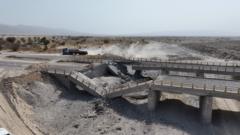
Centcom refuted Iran's state-run Fars agency's claims that its forces had hit civilian infrastructure, including bridges, a train station, and an airport within Iran. However, provincial authorities in Iran's southern Hormozgan province reported that seven people were killed in the attacks. Verified footage shows damage to the Gariveh Bridge, with daylight images revealing a collapsed road section.
This marks one week of nightly U.S. attacks, occurring after peace talks with Iran collapsed. Tensions have been heightened by disputes over the future of the Strait of Hormuz, impacting efforts to broker a permanent ceasefire. Iran's armed forces had previously claimed to have attacked multiple U.S. military facilities across the Gulf region, including in Kuwait, Bahrain, Jordan, and Syria, claims that the U.S. denied.
The ongoing conflict raises concerns about regional stability and the security of critical international shipping lanes. The full extent of damage and casualties on both sides continues to be assessed, with conflicting reports emerging from official sources and state-controlled media.
Unresolved questions remain regarding the ultimate objectives of both nations' military actions and the potential for further escalation. The international community is closely monitoring the situation, given its implications for global energy security and broader geopolitical dynamics in the Middle East.
This article was written by AI based on publicly available news reporting. Original reporting by the linked source.