Wildfires Force 300,000 Evacuations as France, Spain Battle Blazes
Over 300,000 evacuated as devastating wildfires, fueled by heatwaves, scorch France and Spain, creating extreme fire thunderstorms.
Wildfires are raging across France and Spain, forcing over 300,000 people to abandon their homes amidst a sweltering European summer. France is experiencing its most severe wildfires in two decades, while officials in Madrid have described the current blazes as the worst the region has ever encountered. These events follow a period of intense heatwaves across the continent, with temperatures frequently exceeding 40C (104F).
In Spain, three separate wildfires in the mountains near Madrid have collectively consumed an estimated 297 square miles (770 sq km), an area larger than the Spanish capital itself. The situation in France is particularly dire in the Gironde region, near Bordeaux, where more than 200,000 residents have been displaced. The fires there have spread rapidly through forests and fields, engulfing over 162 square miles (420 sq km) in under four days – an area roughly four times the size of Paris. The blaze is now dangerously close to Bordeaux, just nine miles (15km) from its southern edge.
The escalating fires in France have also posed a threat to critical infrastructure, including sites involved in French ballistic missile production, rocket motor development, and hazardous chemical processing. Satellite imagery over Gironde reveals vast expanses of scorched earth, with smoke plumes drifting eastward inland. The extreme heat generated by these infernos has even led to the formation of self-sustaining fire thunderstorms, a rare meteorological phenomenon.
These fire thunderstorms occur when intense heat from a wildfire causes air to rise rapidly, carrying smoke, ash, and water vapor high into the atmosphere. As this air cools, water vapor condenses into clouds. If the fire is sufficiently powerful and the atmosphere unstable, these clouds can develop into cumulonimbus formations, capable of producing lightning. This lightning can then ignite new fires, exacerbating the already dire situation. While these storms can occasionally bring hail and rain, their unpredictable nature, including the risk of new ignitions, significantly complicates firefighting efforts.
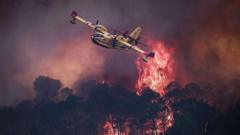
To combat these extreme conditions, French firefighters are employing a range of tactics, including the use of planes equipped with fire retardant and specialized Canadair aircraft. These planes can scoop 6,000 liters of water from lakes or the sea in just 12 seconds and deliver it directly onto the flames. On high-risk days, aircraft patrol vulnerable areas, ready to deploy retardant within minutes of a fire being detected. This aerial assault is often coordinated with ground crews who tackle the fires directly, while retardant is strategically laid along the fire's perimeter.
Despite the deployment of approximately 2,500 firefighters, 1,500 military personnel, and 1,200 police officers and gendarmes in Gironde, authorities acknowledge the overwhelming scale of the challenge. Jean Luc Gleyze, an official in Gironde, stated that there are insufficient personnel and resources to effectively combat the fires. "We don't have enough people and enough trucks and even I think France don't have enough," he remarked.
In an effort to halt the fire's advance near Lacanau, large-scale machinery, including bulldozers and mechanical shovels, has been used to create a firebreak. This firebreak, in some sections measuring 100 meters (328 feet) wide, involves clearing all vegetation to create a barrier against the flames, a critical but labor-intensive tactic in controlling wildfire spread.
The ongoing situation highlights the increasing threat of wildfires across Europe, widely attributed to climate change and prolonged periods of high temperatures. The scale of evacuations and the damage to sensitive areas underscore the urgent need for enhanced prevention strategies, resource allocation, and international cooperation in tackling these escalating environmental crises.
This article was written by AI based on publicly available news reporting. Original reporting by the linked source.