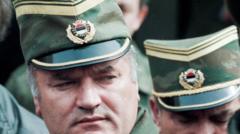
BBC correspondent met fanatical Mladić early in Bosnian war
BBC correspondent Allan Little recalls an early encounter with Ratko Mladić, describing him as dangerously fanatical during the Bosnian war.
BBC special correspondent Allan Little has described meeting Ratko Mladić, the Bosnian Serb commander later dubbed the "Butcher of Bosnia," early in the Bosnian war, characterizing him as "dangerously fanatical."
Little, who reported extensively on the breakup of the former Yugoslavia, recounted his experience in the first hot summer of the war. The conflict saw widespread ethnic cleansing, mass murder, and forced expulsions, with forces under Mladić's command committing atrocities on European soil.
Recalling an encounter at Lukavica barracks near Sarajevo, Little described the atmosphere as tense, with paramilitaries present and weapons readily available. He met Mladić, who had just returned from the front lines of Sarajevo. Little noted Mladić's apparent exhilaration from the proximity of the fighting and his intense demeanor.
"He held my hand for many minutes, fixed me with his eye and told me he was the great defender of brotherhood and unity in former Yugoslavia, and that he dreamed of a world in which there would no guns and no war," Little wrote. "He struck me then as fanatical, dangerously so."
Little's account highlights the human cost of the conflict, recounting how he witnessed refugees fleeing their homes, some carrying meager possessions on donkey-drawn carts. He described seeing an 80-year-old man, separated from his wife, whose "pale, almost translucently white skin was stretched across the bones of his face like parchment."
The reporter reflected on how ethnic labels reduced individuals to simple categories, obscuring their diverse identities. "Our convenient ethnic shorthand reduced them to Serbs, Croats and Muslims. But they were also musicians and scientists and doctors and plumbers and farmers and mothers and fathers and brothers and sisters and very often children," he stated.
In the years following Little's encounter, Mladić's forces were responsible for some of the worst war crimes in Europe since World War II. The term "ethnic cleansing" entered the lexicon of war due to their actions in creating ethnically pure Serbian territories.
Forces under Mladić's command were ultimately responsible for the Srebrenica massacre in 1995, where more than 8,000 Bosniak men and boys were killed. Mladić was convicted of genocide, war crimes, and crimes against humanity by the UN war crimes tribunal and died in prison.
This article was written by AI based on publicly available news reporting. Original reporting by the linked source.