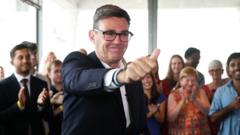
Burnham Finalizes Cabinet Ahead of Monday Prime Minister Appointment
Andy Burnham is finalizing his cabinet choices before becoming Prime Minister on Monday, promising a government that reflects diverse party and community interests.
Andy Burnham confirmed on Friday that he is in the process of finalizing his cabinet appointments ahead of officially taking over as Prime Minister on Monday, succeeding Sir Keir Starmer. The new Labour leader stated that announcing his top team before assuming office would be premature and could lead to chaos.
Burnham's impending premiership follows a period of significant political transition, with his leadership of the Labour Party solidified earlier in the week. He secured the backing of 379 Labour MPs and all 11 affiliated trade unions, positioning him as the sole candidate for the leadership. His formal transition to Prime Minister will occur on Monday after a reception with King Charles III.
Speculation has been rife regarding Burnham's cabinet selections. Notably, Ed Miliband and Shabana Mahmood are reportedly being considered for the crucial role of Chancellor, potentially replacing Rachel Reeves. In his initial address after becoming party leader, the former mayor of Greater Manchester articulated a vision for his government that includes substantial reforms to the social care system.
The implications of Burnham's appointments and policy directions are already drawing reactions from across the political spectrum. Reform UK leader Nigel Farage criticized Burnham's accession, stating he lacked a mandate and called for an immediate general election. Conversely, Lib Dem leader Sir Ed Davey expressed openness to Burnham's call for more collaborative politics, indicating a willingness for the Liberal Democrats to engage, particularly on issues like water industry reform, NHS support, and social care improvements.
Burnham, who recently returned to Parliament via a by-election a month ago, has consistently advocated for a shift in governance. His speeches have emphasized devolving power away from Westminster to the regions, a central theme since he announced his leadership bid. He has pledged to deliver significant change, rejecting past neoliberal policies and vowing to reindustrialize the country.
Addressing Labour MPs, Burnham stressed the importance of unity, stating his intention to build a "one Labour team" culture. He warned against internal divisions hindering the party's progress, particularly in confronting the "new right." His approach to governing, he indicated, would prioritize problem-solving over partisan point-scoring.
While his first speech as leader was light on specific policy details, Burnham has identified reforming the social care system as a top priority. He indicated a willingness to invest considerable political capital into addressing what he described as a "broken" system. Further policy announcements are anticipated as he prepares to move into Downing Street.
Burnham's vision extends to giving "hope back to working-class communities" that he believes have been neglected by the political establishment. His plan, he stated, is clear, and he is ready to implement it, aiming for a government that reflects "all parts of our party and all communities."
This article was written by AI based on publicly available news reporting. Original reporting by the linked source.