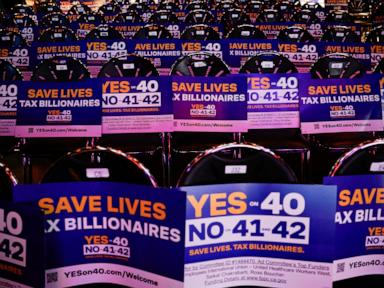
California voters reject 'billionaires' tax' Proposition 40
California voters have rejected Proposition 40, a proposed 5% tax on billionaires, according to AP projections.
Voters in California have rejected the state's "billionaires' tax" ballot initiative, known as Proposition 40, according to projections from The Associated Press on Monday. The measure would have imposed a 5% tax on net worth for California taxpayers and trusts with assets exceeding $1 billion.
The proposed tax was introduced as a response to significant cuts in California's healthcare funding, which stemmed from the passage of President Donald Trump's "Big Beautiful Bill." Proponents of Proposition 40, organized under the group Yes on 40, had estimated that the tax would generate approximately $100 billion over a five-year period. This measure was designed to impact an estimated 200 of California's wealthiest individuals.
Opponents of the tax, primarily represented by the group Building a Better California, mounted a substantial fundraising campaign, collecting $333.1 million since the beginning of the year. A significant portion of these funds came from billionaires themselves. Sergey Brin, co-founder of Google, emerged as the top individual donor, contributing $102 million to the opposition's efforts. Other major donors included those identifying their occupation as investor/philanthropist, CEO, and chairman, contributing millions to the campaign.
The measure faced strong opposition from various sectors, including tech investors. Governor Gavin Newsom became a prominent critic, voicing concerns that billionaires could circumvent the tax by relocating out of state. Newsom has publicly advocated for an alternative: a national wealth tax focused on loans against assets. Meanwhile, proponents like Senator Bernie Sanders and Representative Ro Khanna championed Proposition 40, viewing it as a potential precedent for a nationwide wealth tax.
Khanna, in early October, described a divergence in views with Newsom on the issue, suggesting political motivations tied to campaign financing. He questioned whether the Democratic party would prioritize working-class interests over those of major donors. The opposition campaign's significant financial backing, largely from wealthy individuals, underscored the high stakes and intense lobbying efforts surrounding the initiative.
The geographic distribution of donations to the opposition also highlighted concentrated wealth in specific California regions. Millions were contributed by donors based in San Rafael, West Hollywood, Redwood City, and San Francisco. However, the largest single contribution originated from Sergey Brin, who is based in Reno, Nevada, indicating a broader regional involvement in the opposition's funding.
The rejection of Proposition 40 leaves the state's healthcare funding structure unchanged by this specific measure, and the debate over wealth taxation in California and nationally is likely to continue. The substantial financial resources deployed by both sides suggest the issue of taxing extreme wealth remains a contentious topic.
Questions remain about future legislative or ballot initiatives aimed at addressing wealth inequality and state revenue needs. The differing perspectives between proponents and opponents, including prominent political figures, suggest ongoing political maneuvering and debate on the economic policies affecting the wealthiest individuals and the state's public services.
This article was written by AI based on publicly available news reporting. Original reporting by the linked source.