Canadian Wildfire Smoke Triggers Air Quality Emergencies Across Over a Dozen US States
Smoke from nearly 900 Canadian wildfires caused unhealthy air quality alerts across more than a dozen U.S. states, prompting emergency declarations.
Dense wildfire smoke billowing from Canada has triggered air quality emergencies across more than a dozen states in the U.S. Midwest and Northeast, officials announced Friday. Philadelphia issued a Code Purple Air Quality Emergency Day, warning that everyone may experience negative health effects from the particulate matter, with sensitive groups facing more serious risks.
Canada is currently battling nearly 900 wildfires, with over 100 raging out of control. The province of Ontario alone has almost 200 fires. This widespread burning has sent plumes of smoke southward, significantly degrading air quality in major population centers.
The unhealthy air stretches from Duluth, Minnesota, to Richmond, Virginia, impacting states including Wisconsin, Michigan, Ohio, New York, Pennsylvania, New Jersey, Maryland, and Delaware. By Friday afternoon, the most severe air quality conditions were anticipated in areas spanning Detroit, Cleveland, Pittsburgh, and Washington, D.C.
Forecasters predict a slight reprieve for Detroit and Chicago by Saturday morning, but heavy smoke is expected to persist from Buffalo, New York, to Boston and Washington, D.C. The smoke's trajectory suggests it will cover New England and return to the Great Lakes region by Saturday evening. There is also a probability of smoke returning to New York City on Sunday, potentially impacting the FIFA World Cup Final in New Jersey.
While passing showers and thunderstorms are forecast for some fire-affected areas in Canada, including Ontario, officials caution that this precipitation may not be sufficient to extinguish the blazes. Furthermore, strong winds associated with these storms could exacerbate fire activity and spread smoke more erratically. More significant chances for rain are anticipated over Ontario from Sunday through Tuesday.
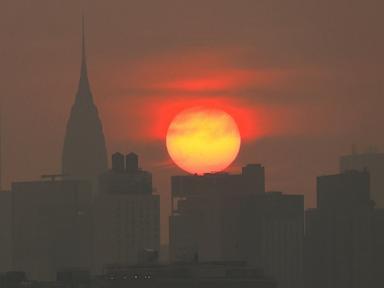
The visual impact of the smoke has been dramatic, with hazy skies obscuring the sun and landmarks in major cities. Images from New York City show the sun barely visible behind skyscrapers, and similar scenes have been reported in Washington, D.C., where the smoke has muted the normally clear views of national monuments.
Authorities are closely monitoring the situation and its potential health implications. The long-range transport of wildfire smoke is a growing concern, particularly for vulnerable populations such as the elderly, children, and individuals with respiratory or cardiovascular conditions. Public health advisories are in effect in many affected regions.
Experts continue to study the long-term effects of wildfire smoke exposure and the increasing frequency and intensity of such events, which are often linked to climate change. The current situation highlights the transboundary nature of environmental challenges and the need for coordinated responses to mitigate their impact.
This article was written by AI based on publicly available news reporting. Original reporting by the linked source.