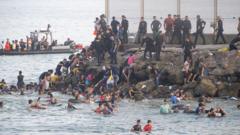
EU demands stronger borders after 70,000+ migrants cross into Ceuta
EU leaders are calling for reinforced external borders after tens of thousands of migrants entered Spain's Ceuta exclave from Morocco.
European Commission President Ursula von der Leyen has urged a united front on border security following the mass entry of migrants into Spain's Ceuta exclave from Morocco.
This influx, which saw approximately 69,500 migrants return to Morocco, has prompted emergency talks among EU interior ministers and highlighted existing strains between member states.
Von der Leyen, in a letter to Spanish Prime Minister Pedro Sánchez, acknowledged his swift crisis management but stated the incident underscores the need to "do more to further strengthen our borders at critical points." The official death toll reported on the Spanish side stands at 72, with 11 fatalities on the Moroccan side.
The situation has triggered calls from some EU nations for a temporary suspension of Spain's Schengen membership, a move that has drawn criticism from Spain's government. Italy temporarily suspended the Schengen arrangement with Spain in response to the crossings, a decision supported by Finland and Denmark.
Prime Minister Sánchez expressed serious concerns regarding the reactions of some European governments, noting that Ceuta is not part of the Schengen area. He characterized some responses as driven by prejudice, misinformation, ignorance, or political motives, contrasting them with expressions of solidarity.
In her communication, von der Leyen emphasized that protecting external borders is a "shared European responsibility" and advocated for vigilant monitoring and the use of physical barriers where necessary. The upcoming video conference is intended to draw lessons from the Ceuta events and formulate a "common European response" to the challenges of irregular migration.
The EU Commission president outlined five key areas for enhanced action: preventing irregular migration through cooperation with partner states, strengthening external borders, implementing early warning systems, dismantling smuggling networks, and reinforcing return procedures.
Spain's government has attributed the surge partly to a recent court decision that limited its ability to immediately deport individuals arriving by sea. The country's Interior Minister stated that the situation was nearing normalization and mentioned ongoing work on an inflatable barrier to deter sea-based illegal migration.
This article was written by AI based on publicly available news reporting. Original reporting by the linked source.