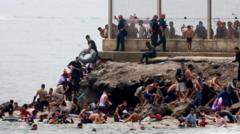
EU Calls Emergency Meeting After 60,000 Migrants Storm Spanish Enclave
The EU convenes emergency talks as 22 member states demand coordinated action following a mass migrant influx into Spain's Ceuta.
The European Union is set to hold emergency talks on Tuesday to address a significant migration crisis in Ceuta, the Spanish enclave bordering Morocco. The urgent meeting follows a joint letter from 22 member states calling for coordinated action and enhanced EU external border security, after approximately 60,000 migrants entered the territory. The situation has led to diplomatic friction, with Spain condemning what it termed "selfish, polarising and unlawful reactions" from other member states.
This surge in arrivals has prompted concerns about the EU's migration policy and external border management. Spain found itself at the center of diplomatic tensions after Italy suspended its participation in the EU's border-free Schengen arrangement with Spain, a move subsequently supported by Finland and Denmark. Officials reported that nearly all migrants who entered Ceuta on July 30 have since returned to Morocco, though the influx resulted in at least 67 reported deaths.
The joint letter from the 22 EU members highlighted concerns over "hybrid threats" aimed at creating the perception of easy illegal entry into the European Union. Signatories, including leaders from the Netherlands, Finland, and Belgium, warned that such perceptions could encourage further migration attempts, erode confidence in common migration policies, and have widespread repercussions across all member states. The letter was addressed to EU President Antonio Costa, European Commission President Ursula von der Leyen, and Irish Taoiseach Michael Martin, whose country currently holds the EU Council presidency.
Spanish Prime Minister Pedro Sánchez expressed "serious concerns" about the reactions of some European governments in a separate letter to Ursula von der Leyen. He asserted that Spain had successfully restored border control and prevented onward movement into continental Europe within 48 hours. Sánchez stated that while most European partners showed solidarity, others attacked Spain, driven by prejudice, misinformation, ignorance, or political motives. He also pointed out that Ceuta is not part of the Schengen area, implying that the suspension of Schengen rules with Spain was unwarranted.
The crisis has underscored existing debates around the Schengen Area, a zone that has eliminated internal border checks for over 450 million people across 29 European countries. Italian Prime Minister Giorgia Meloni's decision to suspend Italy's Schengen agreement with Spain for a month, along with Finland, France, and Portugal considering similar measures, reflects a growing unease among some nations about managing external borders.
Spanish authorities attributed the initial surge to migrant traffickers exploiting a recent Spanish Supreme Court ruling that limited the government's ability to immediately deport sea arrivals. Spain's Interior Minister, Fernando Grande-Marlaska, announced on Saturday that the situation had largely normalized, with businesses reopening and efforts underway to implement preventative measures, including an inflatable barrier for sea crossings.
Despite the government's assurances of restored control, the incident has ignited a broader diplomatic headache for Spain. The scale of the influx and the varied responses from EU partners highlight the complex challenges of managing migration flows and maintaining solidarity within the bloc, particularly concerning external frontiers.
Questions remain about the long-term strategies for border security and migration management within the EU. The emergency meeting is expected to focus on proposals for coordinated actions, potential revisions to border control protocols, and how to address the root causes of migration, while navigating the differing political interests and security concerns of member states.
This article was written by AI based on publicly available news reporting. Original reporting by the linked source.