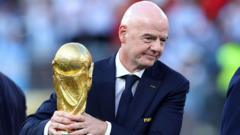
Infantino Faces Ouster After Failed FIFA Competition Stake Sales
FIFA President Gianni Infantino's position is threatened after a failed attempt to sell stakes in competitions, leading to widespread backlash.
FIFA President Gianni Infantino's leadership is under severe pressure following a controversial attempt to sell stakes in FIFA competitions to private investment firms, reportedly without the knowledge of other key stakeholders. The move, which came to light earlier this week, has triggered significant backlash from major football confederations and internal FIFA officials, casting doubt on Infantino's seemingly unassailable position.
This incident marks a dramatic turn for Infantino, who was considered to be in a strong position as FIFA president just days ago. The core of the controversy lies in his alleged unilateral decision-making regarding the sale of future competition revenues, a move that has been met with dismay and calls for review from various footballing bodies. The implications of this failed maneuver could be far-reaching, potentially destabilizing FIFA's governance and Infantino's presidency.
UEFA, a long-standing critic of Infantino, has been at the forefront of the opposition. The European football governing body threatened to boycott all FIFA competitions, including the World Cup, signaling a significant challenge to Infantino's authority. This threat, coupled with a strong statement from UEFA declaring a loss of confidence in Infantino's leadership, suggests a unified front against the FIFA president. The situation was further exacerbated by Concacaf, the confederation Infantino previously worked closely with, calling for a comprehensive review of FIFA's leadership.
The fallout has extended to Asia, with the Asian Football Confederation (AFC) reportedly shunning Infantino, and even two of his closest allies, senior advisor Carlos Cordeiro and chief operating officer Kevin Lamour, abandoning him. This broad discontent suggests that Infantino's support base is rapidly eroding, creating an opportunity for his opponents to potentially force his removal.
Several avenues exist for Infantino's potential departure. The quickest route would be his resignation, a path taken by his predecessor, Sepp Blatter, in 2015. However, Infantino could also choose to hold out until his re-election in March for a fourth and final term. Alternatively, the FIFA Council could convene an emergency meeting, which requires the support of 19 out of 37 members. If such a meeting is triggered, the Council could call for Infantino's resignation, though he could refuse to comply.
Should the FIFA Council fail to resolve the situation, the matter could escalate to an extraordinary congress of FIFA's 211 member associations. This would require a request from at least one-fifth of the member associations, or 43 countries, in writing. UEFA, with its 55 member nations, is a significant bloc that could help mobilize such a request, alongside other dissatisfied confederations.
As the situation unfolds, questions remain about the extent of Infantino's support within the FIFA Council and among the member associations. The coming days and weeks will be crucial in determining whether Infantino can weather this storm or if the mounting pressure will lead to his premature exit from the helm of world football's governing body.
The recent events highlight the complex and often contentious nature of football politics, where power struggles and governance issues can quickly escalate, impacting the sport on a global scale. The response from various confederations underscores the delicate balance of power within FIFA and the potential for collective action when confidence in leadership is lost.
This article was written by AI based on publicly available news reporting. Original reporting by the linked source.