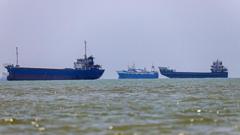
Iran Claims Strait of Hormuz Closed Amid Israeli Strikes, US Disputes
Iran announced the closure of the Strait of Hormuz due to Israeli attacks in Lebanon, but the US military disputes the claim, stating traffic continues.
Iran's military announced on Saturday that it has closed the Strait of Hormuz, a critical global shipping lane, in response to Israeli attacks on southern Lebanon. The Iranian military stated that these strikes violated a prior agreement with the United States aimed at ending the conflict and reopening the vital waterway. The Strait of Hormuz is a chokepoint through which approximately 20% of the world's oil and liquefied natural gas is transported.
This development comes shortly after the US and Iranian presidents signed an initial agreement earlier in the week to end the war, including in Lebanon, with immediate effect. That agreement also stipulated further talks over the next 60 days to reach a final resolution. The reopening of the Strait of Hormuz was a key component of the US-Iran deal.
However, the US military has contested Iran's announcement regarding the strait's closure. A spokesperson for the US Central Command, Tim Hawkins, stated that maritime traffic is continuing to flow through the Strait of Hormuz. US forces are reportedly monitoring the situation to ensure the continued passage of vessels and to confirm that Iran does not control the waterway.
US Vice-President JD Vance departed Washington on Saturday for direct talks with Iran scheduled for Sunday in Switzerland. Vance expressed hope for progress on both the nuclear issue and the Lebanon ceasefire. Regarding the ongoing clashes between Israel and Hezbollah, Vance indicated that the situation was "getting better" and "slowing down a little bit," emphasizing the US goal of ensuring regional safety and security.
Iran's foreign ministry spokesman, Esmail Baghaei, indicated that Tehran would insist on the "other side" fulfilling its commitments under the recent agreement. Pakistan's Prime Minister Shehbaz Sharif was scheduled to attend the initial phase of the talks in Switzerland, with Pakistan having played a mediating role throughout the conflict and previously hosting US-Iran negotiations.
Earlier this week, the US and Iranian presidents signed an initial agreement aiming to end the war, including in Lebanon, with immediate effect. This agreement included a commitment to further talks over the next 60 days to reach a final deal.
The situation in the Strait of Hormuz has been a point of contention in regional security. In February, Iran previously blocked the strait following alleged attacks by the US and Israel against the country.
Adding another layer to the unfolding diplomatic landscape, former US President Donald Trump posted on social media that the US might impose its own tolls on shipping in the Strait of Hormuz if a negotiated deal between the US and Iran was not reached.
This article was written by AI based on publicly available news reporting. Original reporting by the linked source.