Keir Starmer Resigns as Prime Minister, Citing Desire for Change
Prime Minister Keir Starmer announced his resignation, concluding a two-year term marked by economic growth and policy reforms.
Prime Minister Keir Starmer announced his immediate resignation as leader of the Labour Party and the nation's highest office on Tuesday, marking the end of a two-year premiership.
Starmer's departure comes after a period of significant policy shifts and economic developments during his tenure. He inherited leadership of the Labour Party six years ago when it was described as "politically, financially and morally bankrupt."
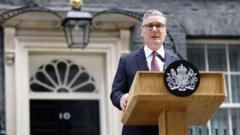
In his resignation speech, delivered on the steps of his official residence, Starmer reflected on his journey into politics, stating his core motivation was to "change the lives of millions of people for the better." He highlighted the party's transformation under his leadership, including efforts to address antisemitism and restore trust in economic and national security policies.
The Prime Minister detailed achievements during his two years in office, citing an economy growing faster than peer nations, wages increasing faster than inflation, and infrastructure projects underway. He also pointed to a significant reduction in NHS waiting lists, improvements in workers' and renters' rights, and increased defense spending. Starmer also mentioned a decrease in small boat crossings, the closure of asylum hotels, and measures to protect young people from social media, alongside lifting half a million children out of poverty.
Starmer also emphasized the restoration of Britain's international reputation, highlighting secured trade deals, support for Ukraine, and rebuilding relationships with European allies. He framed these actions as fulfilling the promises of change that a Labour government had advocated for and delivered.
"The chance to change the lives of millions of people for the better. That's what I came into politics for," Starmer stated, underscoring his commitment to a fairer country with dignity and respect for all.
His decision to step down leaves a vacancy at the helm of the Labour Party and the government, prompting questions about the future direction of the party and the nation's political landscape.
Further details regarding the process for selecting a new leader and the implications for ongoing government policies are expected to be announced in the coming days.
This article was written by AI based on publicly available news reporting. Original reporting by the linked source.