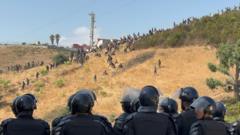
Morocco detains over 100 migrants targeting Spanish exclave Ceuta
Moroccan authorities intercepted over 100 migrants attempting to reach Ceuta, two weeks after a mass arrival crisis.
Moroccan authorities have detained dozens of migrants attempting to cross into the Spanish North African exclave of Ceuta, according to reports. More than 100 individuals were stopped near the border town of Fnideq, as authorities increased security following a previous large-scale influx.
The detentions occurred approximately two weeks after a surge of nearly 78,000 migrants arrived in Ceuta by sea within hours, a crisis that resulted in at least 100 deaths. Moroccan security sources cited by Spanish media and Reuters indicated that 111 people were apprehended in or around Fnideq, with the majority originating from sub-Saharan Africa.
Moroccan police, some in riot gear, reportedly used tear gas to disperse groups of migrants gathered on nearby hills. This action followed warnings from Morocco's government about social media posts encouraging a mass crossing attempt over the weekend, and a pledge to prosecute organizers and participants.
Security measures were significantly heightened in anticipation of further attempts. El País newspaper reported that security at the breakwater entrance was ten times stronger than the previous day. Morocco deployed army officers, navy speedboats, and drones, while Spain bolstered its presence with over 1,500 security officers and installed a metal fence and a floating barrier.
The recent crisis in Ceuta has strained relations between European Union nations. Italy, citing concerns over potential new arrivals, suspended the Schengen free movement arrangement with Spain and implemented border checks on arrivals from Spain. Finland and Denmark supported Italy's stance, while the Czech Republic called for a temporary suspension of Spain's membership.
Spanish Prime Minister Pedro Sánchez reacted critically, emphasizing that Ceuta is not part of the Schengen area, meaning arrivals there do not count as mainland European entry. Spain urged Italy to lift its border controls, subsequently introducing its own as a reciprocal measure.
Italian Foreign Minister Antonio Tajani stated that Italy's actions were precautionary, aimed at carefully controlling arrivals rather than engaging in conflict with Spain. He suggested that Spain should focus its concerns on Morocco, the source of the migration flows, rather than Italy's border controls.
The situation highlights the ongoing challenges of managing migration flows to Europe and the complex diplomatic and security responses required from both North African and European nations.
This article was written by AI based on publicly available news reporting. Original reporting by the linked source.