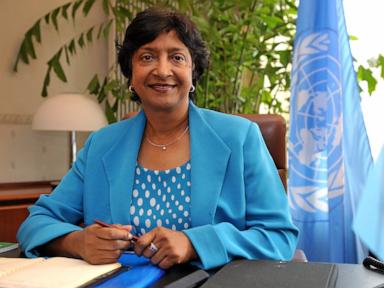
Navanethem Pillay Awarded 2026 Nobel Peace Prize for Championing International Law
Navanethem Pillay, a human rights champion, receives the 2026 Nobel Peace Prize for her lifelong dedication to peace and international justice.
The Nobel Peace Prize for 2026 was awarded Friday to Navanethem Pillay, recognizing her extensive efforts to promote peace and uphold international law. The Nobel Institute lauded Pillay as a figure of exceptional courage and integrity who has significantly advanced a global legal order, ensuring accountability for war crimes, crimes against humanity, and genocide.
Pillay's career is marked by a deep commitment to universal legal principles and a strong moral compass. Born in South Africa under apartheid, she became a pioneering lawyer who confronted systemic discrimination. Her early work included defending anti-apartheid activists, and her career has since spanned pivotal international legal cases.
The Nobel Institute highlighted Pillay's instrumental role in ensuring that severe international crimes are prosecuted. Her dedication to justice and her unwavering adherence to legal standards have made her a respected figure in international jurisprudence. She has served as a judge on the High Court in South Africa, the International Criminal Tribunal for Rwanda, and the International Criminal Court.
Her implications extend to demonstrating how legal mechanisms can deter acts of war and violence. Pillay's work has also been crucial in strengthening international legal institutions. Her independence, expertise, and steadfastness have solidified her reputation as a leading international jurist.
In its citation, the Norwegian Nobel Committee emphasized the critical importance of the rule of law, both nationally and internationally, as the foundation for peace and non-violent conflict resolution. The committee stated that peace is intrinsically linked to justice, underscoring Pillay's contributions in this domain.
Pillay previously served as the United Nations High Commissioner for Human Rights. More recently, she chaired the United Nations Independent International Commission of Inquiry on the Occupied Palestinian Territory. She is currently a judge on the International Court of Justice, involved in the case where Myanmar faces accusations of genocide.
Her career trajectory, from challenging apartheid in South Africa to presiding over international tribunals and tribunals concerning grave human rights violations, illustrates a consistent pursuit of justice on a global scale. The prize acknowledges her long and impactful journey in advocating for human rights and accountability.
The Nobel Institute's decision serves as a reminder of the foundational role of law in maintaining global peace and resolving disputes. Pillay's recognition underscores the ongoing struggle for justice and the power of legal frameworks in preventing atrocities and fostering a more just world.
This article was written by AI based on publicly available news reporting. Original reporting by the linked source.