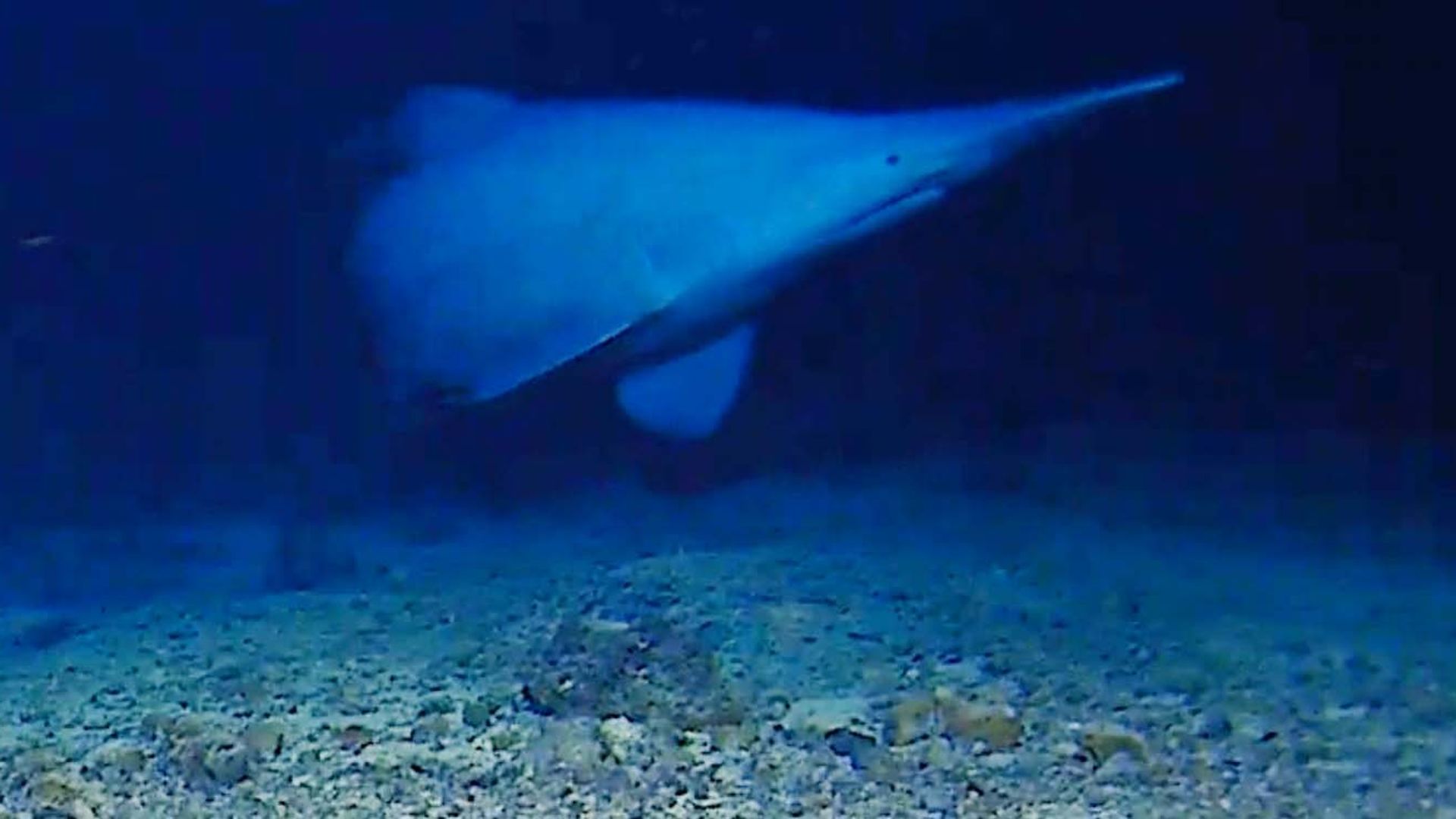
Rare Goblin Shark Studied Alive in Habitat for First Time, Off California Coast
Researchers observed a rare goblin shark alive in its natural deep-sea habitat for the first time, off the California coast.
A rare goblin shark has been studied alive in its natural habitat for the first time, a significant achievement for marine biology. The elusive creature, known for its distinctive appearance, was observed and filmed during a deep-sea expedition.
Goblin sharks (Mitsukurina owstoni) are rarely encountered by humans. They inhabit the deep ocean, typically at depths between 200 and 1,200 meters (660 and 3,940 feet), making direct observation incredibly challenging. Their unique physiology, including a protruding jaw and a pink, flabby body, has led to them being nicknamed "living fossils."
The recent observation occurred off the coast of Southern California, an area not previously associated with frequent goblin shark sightings. Researchers aboard a specialized vessel utilized advanced submersible technology to locate and document the shark in its environment. This marks a pivotal moment in understanding the behavior and ecology of this mysterious species.
This groundbreaking study offers invaluable insights into the life of a creature that has largely remained a mystery. Scientists hope to learn more about its feeding habits, movement patterns, and reproductive strategies. The findings could also shed light on the health of deep-sea ecosystems.
Previously, most knowledge of goblin sharks came from carcasses or specimens caught incidentally in fishing nets. The ability to study one in its natural environment provides an unprecedented opportunity to gather real-time data without the stress and potential harm associated with capture. This method allows for a more accurate assessment of the shark's behavior and its role within the marine food web.
The research team expressed excitement about the discovery, noting that the shark's location was somewhat unexpected. This suggests that the species may have a wider distribution than previously believed, potentially inhabiting areas that have not been thoroughly explored. Further expeditions are planned to confirm these possibilities.
Understanding the distribution and habitat preferences of deep-sea species like the goblin shark is crucial for conservation efforts. As human activities, such as deep-sea mining and fishing, increasingly impact ocean depths, having baseline data on these vulnerable populations becomes essential for effective management and protection.
Questions remain about the specific environmental conditions that attract goblin sharks to certain areas and how they interact with other deep-sea fauna. The success of this initial observation is expected to spur further research into these poorly understood aspects of deep-sea life.
This article was written by AI based on publicly available news reporting. Original reporting by the linked source.