Seven Women's Bodies Found Near Johannesburg Airport, Sparking Femicide Outrage
The discovery of seven women's bodies near Johannesburg's international airport has ignited widespread fear and anger over South Africa's femicide crisis.
The discovery of seven women's bodies in the vicinity of Johannesburg's OR Tambo international airport, with five found in the past week alone, has intensified public fear, grief, and anger over the persistent issue of femicide in South Africa. The grim findings have reignited calls for more decisive action against gender-based violence.
South Africa grapples with one of the highest femicide rates globally, a crisis that has been declared a national emergency by President Cyril Ramaphosa. Despite this declaration, activists and victims' families express deep frustration over the perceived lack of concrete progress and effective action from the government.
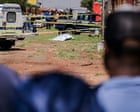
One of the recent victims, 38-year-old Elizabeth "Tsontso" Moselakgomo, was reported missing on September 9 after going for a run. Her body was discovered on Saturday and identified by relatives on Monday. Her disappearance had gained significant viral attention. Police stated that four women's bodies had been found in Kempton Park, near the airport, since July 15. These victims were reportedly found half-naked with visible bruising. Two more bodies were discovered in Olifantsfontein, and a seventh, naked and decomposed, was found further south-east.
The escalating violence has prompted an outpouring of distress, with one individual, Sakane Mokoena, posting on Instagram, "In this country we are prey," following the confirmation of her friend Moselakgomo's death. The ongoing discoveries highlight the perilous environment many women face, particularly in areas surrounding the major international transport hub.
Official police data from the year ending March 31, 2024, indicates a severe problem, with over 27,600 murders recorded, including 5,578 women. This statistic underscores the scale of the femicide epidemic that has plagued the nation for years.
For years, women's rights organizations have been advocating for the government to address gender-based violence with greater urgency. Following protests by hundreds of women on the eve of the G20 summit in Johannesburg in November 2025, President Ramaphosa acknowledged the crisis. However, this acknowledgment has not translated into the tangible results that campaigners and the public are demanding.
Specialist officers are currently investigating the latest string of deaths. Police have acknowledged the fear circulating in the Kempton Park area, stating, "Women in and around Kempton Park are u..." (The sentence was incomplete in the source material).
This series of discoveries raises critical questions about the effectiveness of current strategies to combat gender-based violence and the safety of women in South Africa. The lack of progress fuels ongoing public outcry and demands for accountability and more robust protective measures.
This article was written by AI based on publicly available news reporting. Original reporting by the linked source.