Trump Threatens More Strikes on Iran; Tehran Warns of "Fearless" Response
President Trump declared a ceasefire with Iran over, vowing more strikes, while Iran's foreign minister promised a "fearless" response.
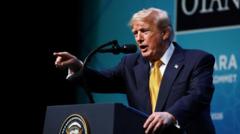
President Donald Trump announced on Wednesday that the ceasefire agreement with Iran is over, escalating tensions following overnight exchanges of fire. Speaking at a NATO summit in Turkey, Trump characterized Iran's leadership as "scum" and "cuckoo," stating that the U.S. had "hit them very hard last night and will probably hit them hard again tonight." He accused Tehran of violating an interim deal signed in June that stipulated an end to hostilities.
This declaration follows the most significant exchange of strikes between the U.S. and Iran since the memorandum of understanding (MoU) was agreed upon on June 17. The deal included a 60-day ceasefire period for negotiations, provisions for the safe passage of vessels through the Strait of Hormuz, and the lifting of U.S. sanctions on Iran. Trump expressed his dissatisfaction with Iran's actions, stating they "lie and cheat" and that he no longer wishes to engage with them.
In response to Trump's remarks, Iran's Foreign Minister Abbas Araghchi posted on X, "We do not answer vulgarity with vulgarity, but with action: fearlessly and with great valour." This defiant statement signals Iran's readiness to retaliate against further U.S. aggression.
The implications of this breakdown in the ceasefire are significant, potentially leading to a renewed period of intense conflict in the Middle East. U.S. Central Command confirmed it had launched strikes in response to attacks on three tankers in the Strait of Hormuz. Iranian state media reported that eight Iranian army members were killed in U.S. strikes in Bandar Abbas and Bushehr.
Adding to the escalation, the U.S. has revoked its temporary suspension of sanctions on Iranian oil sales. In retaliation, Iran announced on Wednesday that it had targeted U.S. military sites in Bahrain and Kuwait. Oil prices saw an increase following Trump's comments, though they remain below previous peaks associated with a full closure of the strait.
Senior Iranian officials voiced strong opposition to Trump's threats. Ali Akbar Velayati, an advisor to Iran's supreme leader, warned that new U.S. strikes would be met with an immediate response. Kazem Gharibabadi, Iran's Deputy Foreign Minister, viewed Trump's statements not as a sign of strength, but as an acknowledgment of the failure of long-standing U.S. policies based on force and sanctions.
Despite the heated rhetoric, President Trump later told reporters that he did not believe the conflict would reignite and that "anything that happens will be over quickly." However, the U.S. Navy continues to maintain a strong presence, with more than 20 warships patrolling waters across the Middle East as of Wednesday, according to Centcom.
The situation remains volatile, with both sides issuing threats and engaging in military actions. The future of negotiations and the potential for wider conflict hinge on the immediate actions and responses of both the United States and Iran in the coming days.
This article was written by AI based on publicly available news reporting. Original reporting by the linked source.