US Strikes Iran Again; Blasts Reported in Southern Cities
The US launched new strikes on Iran following earlier attacks, with explosions reported in southern Iranian port cities and neighboring Gulf nations.
The United States has conducted a new wave of strikes against Iran, escalating tensions after a series of exchanges between the two nations. Explosions were reported by Iranian state media in key southern port cities, including Sirik and Bandar Abbas, which are situated along the vital Strait of Hormuz shipping lane.
These latest actions follow an announcement by U.S. President Donald Trump that the U.S. would retaliate forcefully for what he described as Iran's bombing of ships. The U.S. Central Command (Centcom) stated that the strikes aimed to degrade Iran's capacity to threaten commercial shipping and mariners in the international waterway.
Centcom reported striking 90 Iranian military targets, which included air defense systems and coastal logistics infrastructure. This action was described as a continuation of offensive strikes executed the previous night. Iranian state media detailed multiple explosions in Bandar Abbas, with missiles reportedly hitting the ports of Sirik and Jask, as well as the island of Abu Musa.
Following the U.S. strikes, Gulf nations reported Iranian attacks. Explosions were heard in Bahrain's capital, Manama, while Kuwait intercepted missiles and drones. Qatar issued a security alert. The extent of the damage from the U.S. strikes is still being assessed, though Iranian media reported power outages in Chabahar and a fire at an Islamic Revolutionary Guard Corps (IRGC) barracks in Bushehr.
President Trump, speaking from Air Force One, framed the strikes as retribution, posting on Truth Social that "This is in retribution for yesterday's bombing of ships by Iran. If it happens again, it will get much worse!" He also indicated that Iran had recently sought a deal, but expressed doubt about their reliability.
Iran's parliamentary speaker, Mohammad Bagher Ghalibaf, who also serves as the country's chief negotiator with the U.S., responded via X, stating that "America still hasn't learned that bullying and breaking promises are no longer cost-free." He asserted that "if you strike, you'll get hit," and declared that the Strait of Hormuz would only open under Iranian terms.
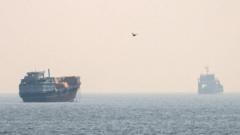
Earlier on Wednesday, Centcom had explicitly held Iran accountable for what it termed "recent unjustified aggression against commercial shipping and civilian crews." The U.S. military had previously announced powerful strikes on Tuesday in response to attacks on three tankers in the Strait of Hormuz.
The escalating conflict raises concerns about the stability of global shipping routes, particularly through the Strait of Hormuz, a critical chokepoint for oil transport. The ongoing exchange of hostilities highlights the fragile security situation in the region and the potential for further escalation.
This article was written by AI based on publicly available news reporting. Original reporting by the linked source.