Watch Wednesday's partial solar eclipse safely using household items
With eclipse glasses scarce, UK residents can use pinhole projectors or colanders to view Wednesday's partial solar eclipse safely.
For those in the UK unable to obtain specialist eclipse glasses in time for Wednesday evening's partial solar eclipse, several household items offer safe viewing alternatives. The event marks the country's most significant eclipse since 1999, though it will be a partial view compared to the total eclipse visible in parts of Spain, Greenland, and Iceland.
Experts strongly advise against looking directly at the Sun without proper protection. Standard sunglasses or dark goggles are insufficient and can lead to serious eye damage due to inadequate UV protection, according to The Royal Astronomical Society. The scarcity of eclipse glasses, with many online orders delayed and shops depleted of stock, necessitates these alternative methods.
One recommended method is the pinhole projector. This can be constructed using a piece of card with a small hole, approximately the size of a ballpoint pen tip, made in its center. By holding the card in one hand and a blank piece of paper in the other, with your back to the Sun, you can align the card and paper to project a miniature image of the Sun onto the paper, revealing the eclipse's shadow.
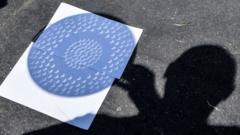
Another accessible option involves using a kitchen colander. Consultant ophthalmologist David Jones suggests holding a colander up to the Sun while looking away from it. This method projects multiple small images of the Sun onto a surface, creating a kaleidoscope effect that allows for viewing the eclipse without direct solar exposure.
A more involved but potentially clearer method is the pinhole viewer, which can be made from an empty cereal box. This device blocks ambient light, allowing only the light from the eclipse to enter. A piece of paper is taped inside the box to act as a screen. A small hole covered with foil, pierced with a pin, is made on the top of the box to allow light in, projecting the eclipse image onto the paper screen inside.
These methods leverage the principle of projection, where an image of the Sun is cast onto a surface rather than viewed directly. This indirect viewing protects the eyes from harmful solar radiation. The Royal Astronomical Society endorses these techniques as safe alternatives when specialized glasses are unavailable.
The upcoming partial solar eclipse is a significant astronomical event for the UK. While not a total eclipse, its rarity provides a unique opportunity for public engagement with celestial phenomena. Educational institutions and astronomical groups often promote such events to foster interest in science and astronomy.
As the event approaches, public awareness campaigns have highlighted the dangers of unsafe viewing practices. The limited availability of certified eclipse glasses underscores the importance of understanding and utilizing these safe, alternative viewing methods to ensure public safety during this captivating natural spectacle.
This article was written by AI based on publicly available news reporting. Original reporting by the linked source.