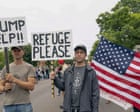
White South Africans Denied US Refugee Status After Believing 'White Genocide' Claims
Dozens of white South Africans have been rejected from a US refugee program, leaving them dismayed after Trump falsely claimed 'white genocide'.
Dozens of white South Africans seeking refugee status in the United States have been denied, leaving many confused and dismayed after believing claims of a "white genocide" in their home country. The rejections come after a US refugee program, expanded by former President Donald Trump to include members of a "racial minority," initially welcomed thousands of Afrikaners.
Trump's executive order in February 2025, which stated the US would accept Afrikaners as refugees, was based on the false premise of widespread persecution against white South Africans. This announcement led many white South Africans, who felt they were victims of racism, to believe their pleas for asylum had been answered. The program saw its first group of 68 white South Africans arrive in May 2025, at a time when the US also halted its refugee program for others fleeing war and persecution.
Since the program's inception, over 13,000 Afrikaners have relocated to the US, with an acceleration in arrivals noted in August 2026, when more than 2,600 were admitted, according to state department figures. The Afrikaner population, descended from Dutch and French settlers, held power during South Africa's apartheid era, benefiting from a system that ensured white safety and wealth. However, since the end of apartheid over three decades ago, affirmative action policies have aimed to create a more inclusive society, leading to a black elite and middle class.
Official data indicates that approximately 38% of black South Africans are unemployed, in contrast to 9% of white South Africans. Policies like "black economic empowerment," coupled with high crime rates that impact all citizens, have contributed to a narrative among some white South Africans that they are now facing racial discrimination. This sentiment has been amplified by the far-right, which has focused on the murders of white farmers, framing these incidents as evidence of a systematic campaign.
Many of those rejected by the US program had believed the "hype" surrounding Trump's announcement and the claims of impending danger. They now face uncertainty about their future and the possibility of returning to South Africa, a country they felt compelled to leave due to perceived racial threats. The situation highlights the disconnect between the political rhetoric that fueled the refugee claims and the realities of the US asylum process.
Experts have noted that the US asylum system requires credible evidence of persecution based on specific grounds, such as race, religion, nationality, political opinion, or membership in a particular social group. Simply experiencing economic hardship or high crime rates, even if disproportionately affecting a certain demographic, does not automatically qualify an individual for refugee status.
The program's expansion to include Afrikaners was a departure from typical US refugee policy, which usually focuses on individuals fleeing war, persecution, or political instability. The emphasis on a specific racial group from South Africa drew criticism and raised questions about the criteria used for selection and the underlying motivations for the policy change.
As more applications are processed and rejected, the long-term implications for both the denied individuals and the US immigration system remain unclear. The situation raises questions about the role of political rhetoric in shaping refugee flows and the responsibilities of governments when such policies lead to dashed hopes and uncertain futures for vulnerable populations.
This article was written by AI based on publicly available news reporting. Original reporting by the linked source.