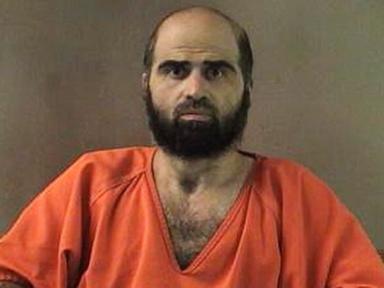
Hasan execution to be live-streamed, Pentagon official confirms
Nidal Hasan's execution will be live-streamed, a Pentagon official confirmed. He is set to be executed by firing squad on December 3.
The execution of Nidal Hasan, the former Army major responsible for the 2009 Fort Hood shooting that killed 13 and injured 32, will be live-streamed, a Pentagon official confirmed to ABC News on Thursday. Hasan, who has described the attack as an act of jihad, is scheduled to be executed by firing squad on December 3 at Fort Hood, the same base where the massacre occurred.
This decision marks a significant departure from modern execution practices in the United States. Public executions, while once common, were largely phased out by the early 20th century, with the last widely recognized public execution taking place in Kentucky in 1936. The Pentagon's decision to allow a live stream of Hasan's execution brings the practice back into public view.
Defense Secretary Pete Hegseth stated that Fort Hood was chosen as the execution site to coincide with the location of Hasan's attack. The 1 p.m. execution time was also selected to roughly align with the time the shooting began. Hegseth indicated that measures would be taken to ensure the public could witness the event, stating "people are able to watch it, that it's public."
The execution order, stemming from President Donald Trump, mandates the use of a firing squad, a method not used by the military since 1945. This directive forced the Army to discard extensive planning that had been underway for a lethal injection execution, a method more commonly used in civilian jurisdictions. The military has had to develop procedures for administering a firing squad execution as it no longer maintains a modern protocol for this method.
John Galligan, Hasan's civilian attorney and a retired Army colonel, confirmed he spoke with Hasan on Wednesday. Galligan noted that Hasan, who represented himself during his court-martial, was informed of the execution approval late at night and without his legal counsel present. The Supreme Court's decision last year to decline a review of Hasan's conviction leaves open the possibility of further legal challenges, such as a habeas corpus petition in federal court, which could potentially delay the execution.
Galligan expressed concerns about the Army's scheduling of the execution, suggesting officials are "pushing to get this done at earliest time possible." He also voiced criticism regarding the choice of Fort Hood as the execution site, citing potential medical concerns for Hasan, though details of these concerns were not fully elaborated in the provided context.
The military has not carried out an execution in 65 years. The choice of a firing squad, a method largely absent from modern execution protocols, highlights the unique challenges and considerations in carrying out this sentence. The military's reliance on this method also comes in the wake of a botched lethal-injection execution in Tennessee.
While the execution date is set, the possibility of legal maneuvers remains. Hasan's legal team has not yet finalized their strategy, but Galligan indicated that filing a habeas petition is "a distinct possibility." The unfolding legal and procedural landscape suggests the path to execution may still encounter further complexities.
This article was written by AI based on publicly available news reporting. Original reporting by the linked source.