Rubio Reassures NATO Allies Amid Conflicting US Troop Deployment Signals
US Secretary of State Marco Rubio addressed allied concerns over troop deployment shifts in Europe following President Trump's announcements.
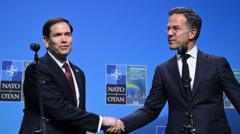
US Secretary of State Marco Rubio sought to alleviate concerns among NATO allies regarding recent, seemingly contradictory, decisions on American troop deployments in Europe. His remarks came at the conclusion of a NATO foreign ministers' meeting in Sweden, attempting to bring clarity to a situation that has sown confusion within the trans-Atlantic defense organization.
The uncertainty stems from a series of announcements made by President Donald Trump. Most recently, Trump declared the United States would send an additional 5,000 troops to Poland. This decision followed closely on the heels of a planned deployment of 4,000 troops to the same country that was abruptly cancelled the previous week. Adding to the complexity, an announcement was also made about the withdrawal of U.S. troops from Germany.
During a press conference held after the NATO meeting, Secretary Rubio explained that the U.S. continuously reassesses its troop presence in Europe in light of its global commitments, including ongoing operations in the Middle East. He stated that the adjustments to troop presence in Europe are "well understood in the alliance" and are being conducted in coordination with allies, emphasizing that this work was already underway.
President Trump's announcement regarding the additional troops for Poland was made via his Truth Social platform, citing his relationship with Polish President Karol Nawrocki, whom he supported in recent elections. The exact nature of these new troops—whether they were a distinct deployment or related to the previously cancelled or planned troop movements—remains unclear. Similarly, the circumstances surrounding the withdrawal of 5,000 troops from Germany, reportedly linked to a dispute between Trump and German Chancellor Friedrich Merz concerning the conflict with Iran, add further layers of ambiguity.
The NATO foreign ministers' meeting in Helsingborg took place amidst this backdrop of conflicting signals. Swedish Foreign Minister Maria Malmer Stenergard, hosting the event, acknowledged the challenging nature of the situation, stating it is "confusing indeed, and not always easy to navigate."
Rubio acknowledged the unease these developments have caused among allies. He reiterated that the United States troop presence in Europe is subject to ongoing adjustments to meet evolving strategic needs and global responsibilities. The coordination with allies is presented as a key element in managing these transitions.
The series of announcements has raised questions about the predictability of U.S. military posture in Europe. Allies are keen to understand the long-term implications of these troop movements and withdrawals for collective security and NATO's strategic planning.
Further details on the specific units involved, the timeline for these deployments and withdrawals, and the precise strategic rationale behind each decision are anticipated. The ongoing dialogue within NATO aims to ensure continued stability and a unified approach to defense.
This article was written by AI based on publicly available news reporting. Original reporting by the linked source.