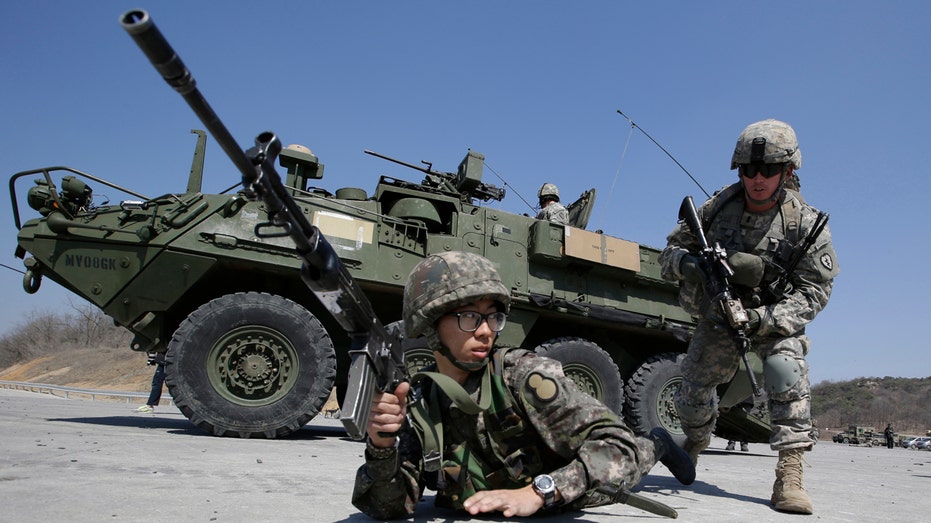
Trump Cuts US-South Korea Drills Amid North Korea Missile Surge
President Trump significantly reduced joint military exercises with South Korea, despite North Korea's escalating missile tests.
President Donald Trump has ordered a major reduction in the scale of joint military drills conducted by the United States and South Korea. The decision comes at a time when North Korea has been intensifying its missile testing activities, raising concerns about regional security.
The move signifies a significant shift in the long-standing alliance's military posture and comes amid ongoing diplomatic efforts to denuclearize the Korean Peninsula. These joint exercises have historically been a cornerstone of deterrence against North Korean aggression, involving thousands of American and South Korean troops.
Details regarding the exact scope and nature of the reduced drills have not been fully disclosed, but sources indicate a substantial decrease in their size and frequency. This scaling back is reportedly linked to President Trump's desire to foster a more cooperative atmosphere with North Korea, following his summits with leader Kim Jong Un.
The implications of this decision are significant, potentially altering the strategic balance in Northeast Asia. Military analysts and regional allies have expressed varying degrees of concern, with some questioning the impact on readiness and deterrence capabilities in the face of North Korea's persistent weapons development.
North Korea has conducted a series of missile launches in recent months, including short-range ballistic missiles, in what is seen by many as a deliberate provocation. These tests violate United Nations Security Council resolutions and have heightened tensions, particularly for South Korea and Japan.
Historically, these large-scale drills have been a regular feature of the US-South Korea alliance, designed to test and improve the combined forces' ability to respond to various security threats. Their reduction is a departure from previous years, where such exercises were often expanded or maintained at high levels of readiness.
South Korean officials have publicly stated their commitment to maintaining a strong defense posture, even as they navigate the complex diplomatic landscape. The alliance's operational readiness and the effectiveness of deterrence strategies are now under renewed scrutiny following the announced changes to the joint military exercises.
Unresolved questions remain about the long-term impact of these drill reductions on the US-South Korea alliance and the broader regional security architecture. The effectiveness of diplomacy in achieving denuclearization without the perceived pressure of robust military exercises will be closely watched in the coming months.
This article was written by AI based on publicly available news reporting. Original reporting by the linked source.